Sunday, July 18, 2010

Lizard Beetle

 This pretty, but very thin beetle is called a Slender Lizard Beetle (Acropteroxys gracilis). The adults are fond of pollen and leaves of herbaceous plants. The larvae bore into the stems of herbaceous plants and feed there. They are found east of the Rocky's and are very tiny at up to 3/8 of an inch. Look for them along roadsides and near woodland areas...or in your garden like I found this one.

They will overwinter in the stems of plants such as Joe-Pye Weed, Sneezeweed and Boneset. These beetles were originally in their own family of Languriidae....now they are included with the Pleasing Fungus Beetles in the family Erotylidae.

Saturday, July 17, 2010

Gold & Brown Rove Beetle

This bland colored beetle is a Gold & Brown Rove Beetle (Ontholestes cingulatus). They are found throughout North America and are associated with dung, carrion and other nasty's. The adults do not feed on poo....they are there to feed on the insects feeding on the poo. The larvae however do...so therefore they are often found in these excrement's feeding on insects or laying eggs. They are one of the largest rove beetles in North America and are all brown with golden coloration near the thorax and on the last abdominal segment. This golden segment has a glowing appearance when first seen that reminds a person of a lightning bug. I have been finding a lot of these beetles on cow dung in out pasture. There are at least two per pile and they seem to prefer fresh dung. The cow patty's that are a day or two old will have no rove beetles on them.

These beetles are incredibly fast and difficult to approach and photograph. I managed two decent photos out of numerous attempts. They race quickly underneath the poo and disappear, sometimes never to be seen again. I draw the line at flipping cow patty's to get at these beetles. I prefer to wait patiently and hope for the best. It just goes to show you never know where you will find interesting insects. :o)

Friday, July 16, 2010

Lubber Grasshoppers

These humongus grasshoppers are called  Eastern Lubber Grasshoppers (Romalea guttata). They are the only lubber grasshopper native to the Eastern United States, although you will not find them in Missouri. I photographed these beauties at the Omaha Zoo at the new Insect Exhibit. I thought they were so beautiful that I wanted to share them with everyone. If you visit our neighboring states of Arkansas and Tennessee, you are likely to find them as they are known to be there, as well as Alabama, Florida, South Carolina, North Carolina, and Georgia. In the west they occur in Texas, Mississippi, and Louisiana. These are extremely large, flightless grasshoppers that measure up to 3 inches in length. Their bodies are thick and heavy. The coloring is a warning of their bad taste, and when disturbed they will secrete a foul tasting fluid and hiss angrily which is sure to ward of potential predators that would typically dine on grasshoppers. I'm sure a bird coming across a grasshopper this large would think it hit the motherlode of all grasshoppers....until faced with the defense system that this large hopper has in store for it.
In the wild they feed on a variety of vegetation, including pokeweed (oh how I wish we had them in Missouri...the pokeweed has taken over my gardens and I fight to keep it at bay), pickeral weed, sedges, arrowhead, and lizards tail. They can be found in a wide variety of habitiats including yards, pine forest, along roadsides, in croplands and open fields. They seem to prefer moist areas. At the zoo they were being fed fresh tomato wedges and other fresh vegetables, which they seem to relish.

Their common name of "lubber" means to be clumsy or lazy.....which may have to do with their slow movements and lack of flight. With a chemical defense such as they have fast movement and flying would not be necessary, this allows them to conserve energy, so maybe it is not being lazy at all, just frugal.

If anyone reading this entry has these grasshoppers in their yards, on their farms or anywhere nearby....I would love to have some to keep in captivity to use for programs with children. Their large size would make them a hit with the kids. I also have an event coming up in September called Insect-O-Rama and would love to have some interesting insects to exhibit there. I will happily pay for postage and handling.

Wednesday, July 14, 2010

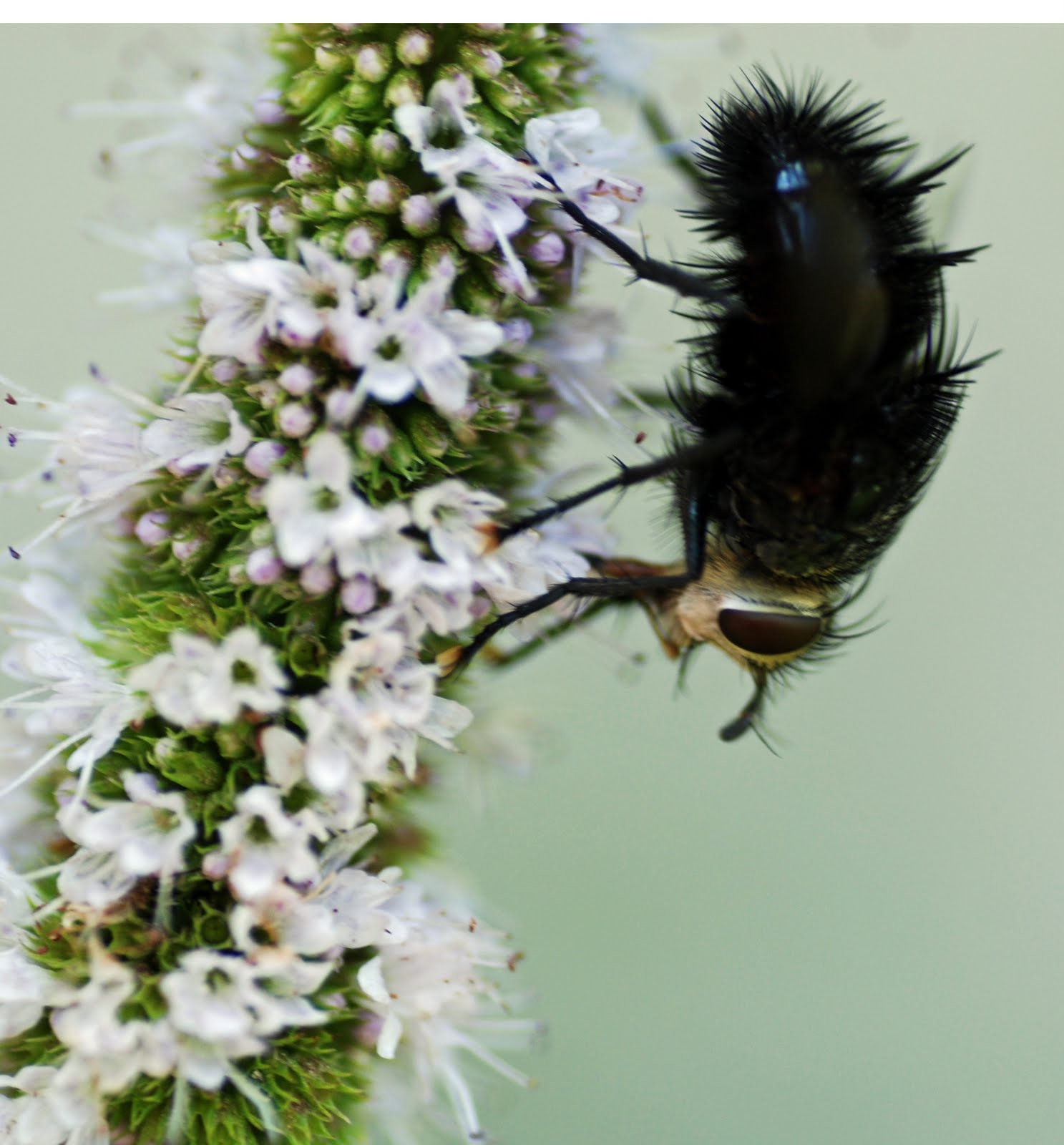
Tachinid Fly


 This large fly is called a Tachinid Fly in the genus Archytas and family Tachinidae. These are large, hairy flies that typically nectar at flowers. Right now my peppermint is in full bloom and it is covered in these enormous flies. There are easily 50 or more nectaring at a time.
These flies start their life out as parasitoids of other insects such as moth caterpillars. The unfortunate host will not survive such an onslaught by the vigorous eating habits of the maggot of these large flies.


These flies do not spread disease to humans, or contaminate food, or eat poo for that matter. Overall these flies have very good manners. Some of them reach enormous sizes...I have a few that are almost 3/4 of an inch in length, maybe larger. They are very thick bodied and covered in bristly hairs.

Males will have eyes that nearly touch, females will have eyes with a noticeable space between them.
I would assume these flies could be considered pollinators from their habit of nectaring at various flowers and spreading the pollen as they do so.

Look for them right now in your gardens among the flowers. They become quite plentiful during the hottest days in the summer.

Tuesday, July 13, 2010

Lynx Spider


 Lynx aren't just four-legged, furry and found in the northern regions of North America feasting on rabbits and mice. There are also lynx right in your very own garden, probably no matter where you live. These lynx are the eight-legged variety and dine on much smaller prey then their larger, furrier namesake. I've often admired the beauty of Lynx Spiders and up until last night had never seen one. I was convinced they did not live in my part of the World. Imagine my shock when I submitted this photo to Spider Identification and Eric (Bug Eric) answered promptly, letting me know I had indeed found a Lynx Spider. This one is called a Striped Lynx Spider (Oxyopes salticus), they can be found in grassy, weedy fields. This one was photographed on our pond dam in the tall grasses. I nearly walked right past it, as it was so tiny at barely 3/8 of an inch. I noticed a movement out of the corner of my eye and discovered this darling little spider, who turned out to be my nemesis! Now I will be on the look-out for more.


It just goes to show you never know what you will find when on a bug hunt. It seems each day brings something new or interesting with it. To say I am excited by the fact that these lovely spiders are here on our farm is an understatement. I know they are considered common, but to me they are precious. 

Happy Hunting guys....see what buggy treasures you can find!

Sunday, July 11, 2010

Black Swallowtail Caterpillar


Black Swallowtail caterpillars are very plentiful this year in my garden. I found one in early May that was feeding on the water celery near our goldfish pond.  I was shocked to see one feeding so early, typically here in NW Missouri I don't see them until the end of July or sometime in August. This past week I found 5 more feeding on the dill. Friday night I brought one in to try and rear it in captivity. Last night she was already trying to pupate and this morning her cocoon was complete.


 This picture shows the alarm response these caterpillars exhibit when disturbed. These odd little orange protuberances pop up out of the head. I'm not sure how this would deter a potential predator, but apparently it works.


This is what she looked like pre-pupation.


This is the sight I woke up to this morning. This is the cocoon fully formed and hanging from the stem of a piece of dill. It should be about 2 weeks and the adult will emerge. I will post pictures. With any luck I will be able to witness the emergence.

Saturday, July 10, 2010

Hanging Thief


This crazy long-legged insect is called a Hanging Thief, they are a type of robber fly and are beneficial to have around. They dine on various insects including many flies, moths and even stinging insects. They are incredible fliers and very fast. Often times they are hard to approach...just look at those eyes. They can see you coming from great distances. This particular one cooperated nicely and let me shoot several pictures before taking off into the garden and out of sight. Flies have long been a favorite group of insects of mine, and these hanging thieves rank right up at the top of my list of all time favorites.


Another Hanging Thief, this one was photographed last year on a farm my in-laws own. The coloration is completely different from the one above indicating two separate species. Unfortunately I do not know which species either of these are despite looking at various websites. It seems they are hard to ID to species. No matter....I can still enjoy them, even if I don't know their "true name".

Monday, July 5, 2010

Hermit Scarab

This flattened-looking beetle is called a Hermit Scarab Beetle (Osmoderma subplanata); They are sometimes called Odor-of-leather-beetle due to the fact that they give off an odor of Russian Leather. They grow to about 2 inches in length and are a beautiful dark chocolate brown.

They feed on decaying vegetation and fruit. This one was photographed last year on a pumpkin vine in my moms backyard. It apparently was feeding on the pumpkin vine. They are slow moving and easy to photograph. These are a perfect insect to use with children, they aren't intimidating, they are slow moving, and will not bite.

There isn't much reported on them, but with the size of the beetle I would assume the grub would be quite large. Most likely they are like many scarab beetles and live underground or in decaying wood and feed on roots or wood.

Saturday, July 3, 2010

Eastern Pondhawk


This beautiful powdery blue dragonfly is the Eastern Pondhawk (Erythemis simplicicollis). They commonly go by the names Common Pondhawk and Green Jacket which is an apt name given their normal Green coloration. They are an averaged sized dragonfly with a wingspan of approximately 3 inches. Easily one of the most common dragonflies in Missouri and are often seen near small ponds and lakes. They will also be found in meadows, open fields and other areas away from bodies of water looking for insect prey.


Thursday, July 1, 2010

Carpenter Bee


I photographed this large, beautiful Eastern Carpenter Bee (Xylocopa virginica) while at work yesterday. It was nectaring at the pond flowers. These bees are often considered a nuisance when they chew holes in wooden structures like our homes. These holes are used by the females to deposit eggs and provision them with masses of pollen and nectar for their offspring. Serious damage comes not so much from the bees and their original holes, but from woodpeckers that are drilling larger holes to get at the bee grubs that they know are hidden inside the holes. Usually the bees will use trees, like conifers for nest provisioning and egg laying. After pupating,the adults overwinter in the nest where they were reared, they become active in the spring.


These bees can get very big at around 1 to 1 1/2 inches in length.  They abdomen is hairless and large. The males have yellow-white faces. There is a fuzzy yellow patch of hair on the thorax. They are not typically aggressive in their temperament.

They can be important pollinators when they aren't robbing flowers by chewing holes along the bottom of the blooms thereby robbing the flower of its nectar or pollen. Open faced flowers benefit from the pollinating efforts of these bees.

Male eastern carpenter bees are curious and will investigate anyone, including humans, that comes near their nests. The curiosity is often interpreted as aggressiveness; however, the males are only aggressive to other male carpenter bees. They do not have stingers and cannot cause any real harm. The female carpenter bees tend to be busy with floral visitation and nest provisioning, but have the ability to cause a painful sting if captured.