Thank you David Steen for bringing this to my attention. This truly is great news and a step in the right direction. I know this blog is primarily dedicated to insects, but news like this begs to be shared. Many of us that love and study insects also share a passion for many other things in the natural world. Please contact the people below and offer your support for the changes taking place.
The following is written by Bill Rulon-Miller of R.A.R.R.
There is breaking news about the Claxton Rattlesnake Roundup in Georgia. This is what Jim Ries of One More Generation and Rise Against Rattlesnake Roundups had to say:
"Beth Grant, Bill Matturro from PALS, Collette L. Adkins Giese from the Center for Biological Diversity, Dr. Lock from the ATL Zoo, Dr. Michael Black from GSU and the OMG Team just got off a conference call with many other folks about the Rattlesnake Round-ups, and we learned truly amazing news!
The Claxton group has decided to convert their March event to the Claxton Rattlesnake and Wildlife Festival without a round-up!!!!!! The folks at P.A.L.S, especially Bill, Carter and Olivia from One More Generation, as well as DNR staff all deserve big kudos for bringing the issues to the Claxton group's attention and helping them come to the conclusion to change their events!
We all need to support them in this for their own sake and also to serve as an example for Whigham. More ideas on this to follow, but to begin with, we all echo the Georgia DNR Chief, Non-game Conservation Section Wildlife Resources Division Georgia DNR, who writes:
I encourage you to contact Bruce Purcell and offer support for his work to change the event to the "Claxton Rattlesnake and Wildlife Festival".
Bruce Purcell 912-282-4052 qkutdist@bellsouth.net
Evans County Wildlife Club
P.O. Box 292
Claxton, Georgia 30417"
Deciding to confirm this, I called Bruce Purcell at the number listed. After a lengthy phone conversation Bruce confirmed that all of this is true. It should be noted that the festival did not have to change but it wanted to and they are hoping for a successful reformation. The last part of this message cannot be emphasized enough: call him, write to him and tell him that you fully support his decision! He is getting some negative feedback and it is the utmost importance that we counter this.
I will also encourage people to visit this reformed festival if at all possible, this may be a victory for rattlesnakes but we cannot abandon the battlefield at such a critical hour! Roundup proponents will push back and it is our duty to stop them in their tracks.

Saturday, January 21, 2012

Sunday, January 15, 2012
Chilean Gold Fluff Tarantula

Today was the bi-monthly reptile show in Overland Park, KS. Joey and I made a trip down there to see what they had this time. The show is always full of large snakes, turtles, alligators, caimans, lizards and various arthropods. Meet the newest addition to my growing menagerie; this lovely tarantula. She is a Chilean Gold Fluff from the mountains of Chile. They can grow to have a 5 inch legspan. This in an incredibly docile spider and they rarely if ever bite. If they would take a notion to bite, their venom is not known to have any serious affects on humans. However, if you are allergic to the venom, then you could have a serious side affect like anaphylaxis. Their diet consists of arthropods, small snakes, lizards, and small rodents.
Like all tarantulas they possess venom to subdue their prey. Limited by their narrow stomach tubes, tarantulas, like other arachnids, cannot eat solid food. Tarantulas expel digestive enzymes that help liquefy their prey for ingestion. After immobilizing its prey, a tarantula chews it with its powerful chelicerae while covering it with digestive enzymes. Contraction of the muscles surrounding the fore-stomach helps the tarantula suck up the liquefied prey through its straw-like mouth and into the mid-gut.
Tarantulas also have a unique defense mechanism, they are able to flick the hairs on their abdomen at a potential predator. They simply turn their body towards the source of the danger and use their back legs to begin flicking irritating hairs in the direction of the predator. These tiny hairs are an extreme irritant that will cause uncomfortable itching. The tarantula can beat a hasty retreat while the predator is busy dealing with a very uncomfortable case of irritation. Some tarantulas are more high strung than others and will often have bald patches on their abdomen where it is evident they have been flicking hairs. When the tarantula sheds its exoskeleton the next time the hairs will return. This is an important defense strategy for the spider so it is vital that the hairs return so it can adequately protect itself.
I currently own 4 tarantulas and I have never witnessed the hair flicking, and I must admit I am thankful. I have heard of people who have gotten these hairs in their eyes and it can be extremely painful. The hairs are so fine that they can embed themselves into your eye and cannot be retrieved. Your only hope is if the hairs finally work their way out of the eye.
I love these incredible spiders, their large size, docile nature and incredible beauty all add up to a great pet.
Friday, January 13, 2012
For Japan Locust Eaters, A Plague of Cesium? By Yoree Koh
Locusts are known for their fondness for feasting on Japan’s lush rice fields.

Less well known is the fact that the bug is also a delicacy in the country’s entomophagous culture – the practice of eating insects, not as widespread in Japan as in some parts of Asia if still popular with a minority.
But a Tokyo scientist, concerned the Fukushima Daiichi nuclear accident may swat the critter off the country’s bug-eating menu, is conducting research designed to save the tasty tradition as well as study the long-term effects of radiation exposure.
While buggy eats like silkworms and larva are gastronomic favorites for those who eat insects in other parts of the country, locusts are a bounty for the insect eaters of rice-producing regions like Nagano, Chiba and the towns of the northeast hit hardest by the March 11 disasters.
But Hajime Fugo, the vice president of Tokyo University of Agriculture of Technology and a physiologist specializing in insects, worried the locust-eating tradition may fall into extinction should connoisseurs shun the bug amid deepening anxiety among consumers over food produced in Fukushima, fearful of radiation hazards.
With a Geiger counter in his pocket, Mr. Fugo, along with two students, in October went to Iitate, a village located over 30 kilometers away from the nuclear plant and where hot spots of high radiation have been discovered. There they collected about 500 grasshoppers, a cousin of the locust which was in short supply in the area because local rice fields were barren. The radiation in the air varied from 2.5 microsieverts to a little over 3 microsieverts per hour at the time.
About 4,000 becquerels of radioactive cesium-134 and cesium-137 was detected in the grasshoppers, all 500 weighing a cumulative one kilogram. The levels far exceed Japan’s regulatory limit of 500 becquerels per kilogram.
Mr. Fugo said the results were astonishing. But the scientist thinks it is safe to eat the bugs because they are usually in snack-sized portions – crunchy soy-marinated locusts – enjoyed with cold mugs of beer. Additional research also showed that the amount of cesium dropped considerably after going through the routine steps taken when preparing the insects for consumption.
In contrast, radiation found in about 2,000 locusts collected further away, about 60 kilometers away from the plant, measured well below the government standard. The highest measurement of the samples reached about 200 becquerels per kilogram. The insects were freeze dried to a consistency comparable to instant coffee before being checked for radiation.
But it’s not all about food safety. Mr. Fugo plans to use the initial findings as a base for what he hopes will elucidate some of the long-term effects of radiation on humans.
One aim is to continue collecting samples from the same areas to analyze how much of the radiation is passed from adult insects to offspring. Because the locust and grasshopper’s breed about three to four months into their life cycle, Mr. Fugo says, studying the bugs may point the way to how much radioactive cesium, which has a half life of about 30 years, is contracted through the insects’ successive generations — much faster than waiting to observe the same process in humans.
A second objective is to dissect the insect to identify which organs are susceptible to higher concentrations of radiation.
Some preliminary results have been interesting. The scientist left one sample of locusts alone until they defecated, a necessary step before cooking the locusts. (It’s advised not to eat locusts raw because of the risk of parasite.) Compared to a group of locusts taken from the same area that did not release droppings, he found the level of radioactive cesium fell by nearly half, from 75 becquerels to 35, among the locusts who answered nature’s call.
Source: Wall Street Journal----Japan

Less well known is the fact that the bug is also a delicacy in the country’s entomophagous culture – the practice of eating insects, not as widespread in Japan as in some parts of Asia if still popular with a minority.
But a Tokyo scientist, concerned the Fukushima Daiichi nuclear accident may swat the critter off the country’s bug-eating menu, is conducting research designed to save the tasty tradition as well as study the long-term effects of radiation exposure.
While buggy eats like silkworms and larva are gastronomic favorites for those who eat insects in other parts of the country, locusts are a bounty for the insect eaters of rice-producing regions like Nagano, Chiba and the towns of the northeast hit hardest by the March 11 disasters.
But Hajime Fugo, the vice president of Tokyo University of Agriculture of Technology and a physiologist specializing in insects, worried the locust-eating tradition may fall into extinction should connoisseurs shun the bug amid deepening anxiety among consumers over food produced in Fukushima, fearful of radiation hazards.
With a Geiger counter in his pocket, Mr. Fugo, along with two students, in October went to Iitate, a village located over 30 kilometers away from the nuclear plant and where hot spots of high radiation have been discovered. There they collected about 500 grasshoppers, a cousin of the locust which was in short supply in the area because local rice fields were barren. The radiation in the air varied from 2.5 microsieverts to a little over 3 microsieverts per hour at the time.
About 4,000 becquerels of radioactive cesium-134 and cesium-137 was detected in the grasshoppers, all 500 weighing a cumulative one kilogram. The levels far exceed Japan’s regulatory limit of 500 becquerels per kilogram.
Mr. Fugo said the results were astonishing. But the scientist thinks it is safe to eat the bugs because they are usually in snack-sized portions – crunchy soy-marinated locusts – enjoyed with cold mugs of beer. Additional research also showed that the amount of cesium dropped considerably after going through the routine steps taken when preparing the insects for consumption.
- Hajime Fugo
- A locust.

But it’s not all about food safety. Mr. Fugo plans to use the initial findings as a base for what he hopes will elucidate some of the long-term effects of radiation on humans.
One aim is to continue collecting samples from the same areas to analyze how much of the radiation is passed from adult insects to offspring. Because the locust and grasshopper’s breed about three to four months into their life cycle, Mr. Fugo says, studying the bugs may point the way to how much radioactive cesium, which has a half life of about 30 years, is contracted through the insects’ successive generations — much faster than waiting to observe the same process in humans.
A second objective is to dissect the insect to identify which organs are susceptible to higher concentrations of radiation.
Some preliminary results have been interesting. The scientist left one sample of locusts alone until they defecated, a necessary step before cooking the locusts. (It’s advised not to eat locusts raw because of the risk of parasite.) Compared to a group of locusts taken from the same area that did not release droppings, he found the level of radioactive cesium fell by nearly half, from 75 becquerels to 35, among the locusts who answered nature’s call.
Source: Wall Street Journal----Japan
Wednesday, January 11, 2012
Here a Moth, there a Moth, everywhere a Moth.......




This moth has a scattered population in the Southern and Eastern portions of the United States. The one pictured here is only one of two I have ever seen. It came to a mercury vapor light I had out to attract insects. These are a medium sized moth with a wingspan up to 2 1/2 inches. The forewings are cream colored with black lines, and the hindwings are bright orange-red with black markings. This species is associated with woodlands. The adults will sip nectar, and the caterpillars use lettuce, plantain, clover and other low growing plants as their host. Like all caterpillars in the tiger moth family, they are referred to as woolly bears. This particular species has one of the fasted moving caterpillars I have ever encountered. It literally looks like it is sprinting as it move across the ground.

crabapple.
(Picture by Steve Scott)
There are at least two generations in Missouri in each year.

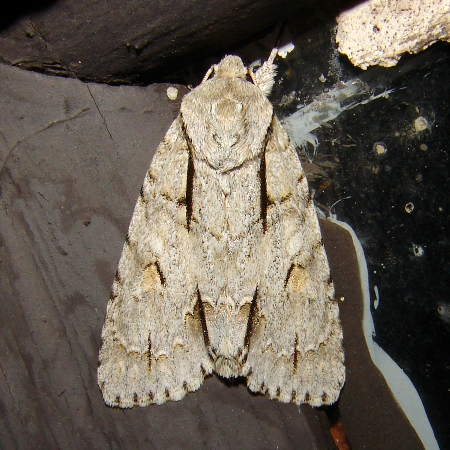
 This lovely light gray moth is the American Dagger Moth (Acronicta americana). They are medium size moth with a wingspan up to 3 inches. The wings contain wavy lines in a variable pattern. They are associated with deciduous hardwood forests and nearby areas. The adults most likely do not feed and the caterpillars use alder, hickory, ash, willow, polar, elm, birch and other as their host. This particular species is the largest of the dagger moths in North America.

Banded Tussock Moths (Halysidota tessellaris) are a beautifully marked moth with distinct aqua blue and yellow striped on their thorax. They are average in size with a wingspan up to 2 inches. Look for them in deciduous hardwood forests and nearby edges. The adults regurgitate decaying plant matter that is high in alkaloids, and then drink up the fluid, which gives them additional toxins as adults.
 The caterpillars use birch, elm, willow, ash, walnut, hackberry, grape, alder, hazel, and oak for their host plant. These plants give the caterpillar a chemical protection from predation by forming distasteful toxins in its system. Most predators would avoid eating this species.
This moth will come to porch lights at night.
All of the moths shown here are found throughout Missouri and most of them will come to porch lights at night. Moths are easily seen and easily captured for study and for collections. Moths are often over looked as being drab and not worthy of our time....after all they are not near as colorful or beautiful as their distant cousins the butterflies....or are they? Many moths are quite colorful and most are beautiful in their own right. Some fly during the day just like butterflies and are often mistaken for them. Soon warm weather will return and so will the moths that have been overwintering in various stages of development. Some as cocoons, some as caterpillars and some as full grown adults.
Many cultures view moths as supernatural beings, and believe that their departed loved ones were encased in the body of the moth as it fluttered about ghost-like in the night sky. Who knows, maybe, just maybe......we ARE being visited by past loved ones when these moths show up in our yards at night. I'm just sayin..."it could happen"
Saturday, January 7, 2012
Winter Bees

I sat and watched the bees for about 30 minutes and found it very relaxing to observe them in their daily activity. Workers would fly out of the hive, and return several minutes later, laden with pollen. Some workers were met at the entrance of the hive by additional workers that would quickly feed them a bit of pollen, before they entered the hive.
Then I noticed several dead bees on the ground below the hive entrance. I assume these are the workers who perished over the last few weeks. They had been swept out the door of the hive; one thing any self-repecting honey cannot abide by is a messy hive. Dead bees would definitely qualify as dirtying up the hive.

Upon further observation I noticed a bee come in for a landing at the entrance, it was not carrying pollen as it slipped inside. It wasn't long before this intruder was rudely escorted out of the hive, onto the ground and stung repeatedly before succumbing to death. The message was loud and clear "Don't come around here, you're not welcome!"

Honey bees will often try to invade the hives of other bees to steal their stores of honey and pollen. The intruders are often quickly detected by scent alone. The robber bees will smell different than the members of the hive and are quickly deposed of. To me it seems a folly on the part of the robber bee, why sacrifice yourself to try and steal some honey? Do the robber bees think it would be easier to risk life and limb, than to gather their own pollen or nectar? Granted this time of year their choices are limited, but still, is it worth dying over?
Occasionally I had to laugh as the bees would fly in to make a landing and seemed to judge the distance all wrong. These bees would crash into the hive, or into the grass around the hive, or sometimes into each other. One little worker crashed into her fellow hive mate, and spun herself around and quickly caught her balance by grabbing her sister bee. It was quite comical, as she held on as if her life depended on it. I am sure she experienced a moment of WTH just happened!? After several seconds she regained her composure and flew into the hive. Silly bee.

I am so excited to see that the bees are doing so well. I realize we have had a mild winter up to this point and that it will most likely change soon. My hope is that they continue to do well and survive any harsh weather that the winter is still likely to throw at us.

Monday, January 2, 2012
Fresh Water Mussels


As you can see the kids were having fun diving for mussels in our pond. What a great way to spend a hot summer day!
There are hundreds of fresh water mussels in the World, and nearly 300 of them live in North America. In fact North America is home to the largest variety of mussels compared to anywhere else in the World. Many are in threat of becoming endangered, in fact the estimate is as high as 3/4 of the known species may be in peril. As many as 35 species have already gone extinct. The Midwestern portion of the United States contains the highest concentration of species, Missouri alone is home to some 65 species. Native Americans utilized mussels as an important part of their diet. Not only were they a valuable food source for tribes throughout the Midwest, but they also held value in other ways. The shells were used for tempering pottery and tools, they also made jewelry, and utensils. In the late 1800's "white man" recognized the potential value of the shells in the fashion industry. The button industry reached a boon during this time in history and many mussels were collected for the "mother-of-pearl" and sold to the button factories. The epicenter for the button industry was right in the good old Midwest.

As many as 200 button factories were in operation by 1912. Barge loads of mussels were harvested each season.This over harvesting of mussels drastically affected the population of mussels. It wasn't until the use of plastics came in vogue during the 1950's that the interest in mussels for buttons waned.
The livestock industry also benefited from the harvest of mussels, by manufacturing livestock feed from the soft parts of the mussels.
With the advent of plastics it seemed as if the mussels would be left to rebound depleted populations, but that was not to be the case. The Japanese discovered that mussels could be used to create cultured pearls. The mussels are boiled and cleaned. The shells are then formed into small beads and inserted into the shells of oysters as an irritant. The oyster will form a pearl around the irritant and the resulting pearl is sold as a "cultured pearl". Thousands of tons of mussels are collected, boiled, cleaned, formed into beads and shipped to Japan for this very lucrative trade. Fourteen states still allow the harvesting of fresh water mussels to be sold for this purpose. There is some indication that certain species of mussels are immune to many types of cancer. There is hope that the components that allow the mussels this immunity will be isolated and will lead to cancer curing medicines to be created.
An added problem mussels face is pollution. Many areas where fresh water mussels occur are heavily polluted. The mussels cannot survive in those conditions. Mussels are filter feeders and consume micro-organisms. In heavily polluted water they are also consuming the chemicals and debris that are present in the water. Because of this sensitivity to pollutants they are considered indicator species. This basically means that biologist can determine water quality by the presence, or lack thereof of the mussels in a given aquatic habitat. Depending upon the circumstances much can be determined about water quality based on these mussels. If a pond that traditionally held mussels, suddenly is mussel free that would "indicate" a severe problem with the water conditions. A sudden decrease of mussels can also indicate a problem in progress. Mussels that remain can be collected and their tissue can be tested for the type of pollutant, and the extent of the pollution that is causing the problem. Many times biologists are able to head off a disaster because of the data collected in the mussels. Mussels are an important part of the aquatic ecosystem, not only for their ability to indicate water quality issues, but because of their ability to filter the water. This filter feeding increases the water quality and creates an overall healthier water ecosystem.

They are also an important component in the food chain. Many animals will consume mussels including herons, and other shore birds, skunks, raccoons, foxes, minks and otters are all huge fans of mussels. Even muskrats that are traditionally plant feeders will utilize mussels as a food source when other food is not available.

The life cycle of mussels is very unique. Males release sperm directly into the water, and the females filter the water and sperm directly into their cavities. Once fertilized the female will carry the eggs and young larvae called glochidia within her gills. Some species will release their larvae the same year they are fertilized, other species carry the young overwinter and release them the following spring.
After being released the journey to adulthood gets interesting. In order for the mussels to complete their lifecycle they must attach themselves to the gills or fins of fish....yes that's right FISH! Who would have thought that mussels rely on fish to survive. The species of fish used is all dependent upon the type of mussel in question. Some mussels have very species specific requirements and will only use one type of fish. For instance Pocketbook mussels need to find small mouth bass. So how do they insure that the proper host is found?

They use a lure in the form of a soft tissue that they wiggle which resembles a small minnow, the small mouth bass is attracted to the "bait" and comes in to investigate. Instead of finding a meal, it finds itself a host to a mouthful of glochidia. Such deceit! Many mussels utilize any fish available, but have a wide variety of methods to attract them. Oyster Mussels open their shells and expose a blue mantle. The bright blue color attracts nearby fish. When the fish swims in closer to investigate the mussel will clamp its shell down onto the fishes head and holds tight. As the mussel holds on the glochidia swim into the fishes mouth. I am sure the fish is much relieved when the mussel finally releases it. The young larvae remain attached to the host fish for up to 7 months depending upon species. Once they have reached maturity they will drop off the fish and lead a sedentary life. Mussels are very limited in their ability to move which is why they rely on fish to spread their populations. Of the millions of eggs produced by females and fertilized by males, only about 1 in a million will survive to the juvenile stage. Mussels are long lived creatures and many species may live a century or more. Other species live for decades and like many long lived animals they do not reach sexual maturity until they are older. Some species may be ready to reproduce at 2 years of age, and others it may not be until a decade later.
Other factors can affect the over all survival of mussels, including habitat destruction. This can be caused from dredging, damming and forming channels. Mussels are vulnerable in other ways too, consider that they have a later maturation rate, very low juvenile survival ratio, susceptibility to pollution, inability to disperse in a sustainable fashion, and host specificity. All these things combined makes a person wonder how they survive at all. On top of all these issues, they also suffer from competition with invasive species. Zebra Mussels have wrecked havoc on many fresh water environments. Zebra mussels originated in Poland and the former Soviet Union. They made their way to North America in the ballast water of ships. They were first discovered in 1988 in Canada, and four years later were found in the United States throughout the Great Lakes. By 1991 they were discovered in the Mississippi River. Humans are responsible in most cases for the expansion of the zebra mussels range. The mussels attach themselves to boats and other water craft and then are carried to new locations. Zebra mussels unlike many mussels have a very sort reproductive cycle which allows them to colonize areas in greater numbers. The presence of zebra mussels causes many problems for native mussels, because of their habit of attaching themselves to natives species. This interferes with feeding, movement, growth and reproduction of native mussels. In Lake Erie alone it is estimated that Zebra mussels are responsible for the 90% reduction of native mussels. It is vitally important that individuals frequently utilizing the water in a recreational manner make sure that their water craft is free of any attached mussels before heading to other waterways. This can go a long way in reducing the spread of these invasive species.
Sometimes the most unassuming creatures perform some of the biggest jobs. While mussels move very little, and are rarely seen they perform a huge job in purifying water, determining water quality, providing product to the jewelry and fashion industry, and providing food for many other animals. We as humans should try to reduce invasive species, limit habitat destruction or alteration, and reduce harvesting especially in locations where native species area already struggling to maintain viable populations. We also need to continue to reduce chemical runoff which greatly impacts these fresh water mussels.

I feel very fortunate to have such a healthy and large population of these mussels present in our ponds. This indicates to me that the water quality is superior and all the right components are in place to allow them to survive and reproduce. Now if I could just figure out how to make them palatable I'd have it made.
Resources: Texas Parks and Rec; MDC; and NRCS
Friday, December 16, 2011
Eastern Blood-Sucking Conenose

This time of year thoughts turn to Christmas and traditions. One tradition many of us are happy to indulge in is sneaking a kiss under the mistletoe with a special someone. No one however would be happy to be kissed by the Kissing Bug. Eastern Blood-Sucking Conenose Bugs (Triatoma sanguisuga) are often referred to as the kissing bug because of their habit of planting a big juicy, albeit painful kiss right on the lips of hapless victims. As if Blood-sucking conenose, and kissing bug weren't weird enough names, they are also called Mexican Bedbugs. None of these names are very reassuring and there is good reason, these bugs are just not something we want to share our homes with. They can and do make their way into our dwellings and once inside they may use us as a source of food. They seem to sense the carbon dioxide coming from our breathing, once they have landed on our mouth they will use their beak-like rostrum (mouth) to pierce our skin and suck our blood. They inject an enzyme along with their saliva that contains a deadening agent that numbs the area being bitten so that you will not feel the initial bite. This enzyme will cause significant problems for some people who have an allergic reaction to it. It can cause nausea, vomiting, fainting spells, red blotches as well as burning, itching and swelling at the bite sight. It can also cause anaphylactic symptoms in some individuals. There are approximately 140 species of conenose bugs in the World, with 15 species found in the United States each belonging to the family Reduviidae. They all have the capability to bite humans but in some parts of the Southwest and into Mexico and areas further south they carry this ability even further by defecating while they feed. This behavior causes the spread of a disease called Chagas disease.

The symptoms of Chagas disease vary over the course of an infection. In the early, acute stage, symptoms are mild and usually produce no more than local swelling at the site of infection. The initial acute phase is responsive to antiparasitic treatments, with 60–90% cure rates. After 4–8 weeks, individuals with active infections enter the chronic phase of Chagas disease that is asymptomatic for 60–80% of chronically infected individuals through their lifetime. The antiparasitic treatments also appear to delay or prevent the development of disease symptoms during the chronic phase of the disease, but 20–40% of chronically infected individuals will still eventually develop life-threatening heart and digestive system disorders. Chagas disease is contracted primarily in the Americas, particularly in poor, rural areas of Mexico, Central America, and South America; very rarely, the disease has originated in the Southern United States. (Taken from Wikipedia)
Females will lay clusters of eggs that hatch in a few days. After hatching, the nymphs must complete up to 8 instars (molts) before reaching adult size. These bugs need blood to survive, it is their sole source of food. Humans are not the first choice when choosing a host, they typically invade pack rat nests and feed on the blood of these mammals. They will also hang out in dog houses or other areas where dogs are bedded. They can and do bite dogs and may spread chagas disease to your pet where the disease is prevalent.
These bugs are nocturnal and are often attracted to lights at night. It is proximity to human structures that often leads them into our homes. Because of their potential to bite they should not be tolerated in our homes. If you notice a significant number of these around your home, you may want to consider extermination. Making sure homes are sealed tight leaving no cracks for them to crawl through should help keep them out of your home. Eliminating areas where rodents would be attracted to will also help as they are frequent feeders on rodents, and will definitely be attracted to areas where mice and rats are located.
There is no reason to live in fear of these bugs, especially in Missouri as they do not occur in large numbers. I've only ever seen two in 20 years. They are harmless outside in their natural habitat feeding on rodents and other mammals. Although I would not recommend sharing the mistletoe with this kissing bandit
Saturday, December 10, 2011
Rarest Bumblebee in US Rediscovered
An elusive bumblebee, which was last seen in 1956, was recently found living in the White Mountains of south-central New Mexico, scientists announced Monday (Dec. 5).
Known as "Cockerell's bumblebee," the bee was first described in 1913 using six specimens collected along the Rio Ruidoso, a river located in the Sierra Blanca and Sacramento Mountains, N.M. Over the years, one more sample was found in Ruidoso, and 16 specimens were collected near the town of Cloudcroft, N.M.
The last Cockerell's bumblebee sample was collected in 1956. No other specimens had been recorded until Aug. 31, when a team of scientists from the University of California, Riverside, found three more samples of the bee species in weeds along a highway north of Cloudcroft.
"When an insect species is very rare, or highly localized, it can fairly easily escape detection for very long periods of time," Douglas Yanega, a senior museum scientist at the University of California, Riverside (UCR), said in a statement.
Cockerell's bumblebee has the most limited range of any bumblebee species in the world, having been spotted only in an area of less than 300 square miles (777 square kilometers), according to the researchers. By comparison, the rare "Franklin's bumblebee" species, which was last seen in 2003 and is on the verge of extinction, is known from a distribution covering about 13,000 square miles (33,670 square km).
Cockerell's bumblebee was able to fly under the radar for so long because the area where the species lives is rarely visited by entomologists, Yanega said. The bee species has also "long been ignored because it was thought that it was not actually a genuine species, but only a regional color variant of another well-known species," Yanega explained.
An assessment of the genetic makeup of the three newly discovered specimens gives fairly conclusive evidence that Cockerell's bumblebee is a genuine species, the researchers said.
It is not unusual for an insect species to be rediscovered after several decades, when people might otherwise have believed it had gone extinct, Yanega said. UCR entomologists rediscover many "lost" insect species like the Cockerell's bumblebee, as well as discover entirely new species, at the rate of several dozen species every year.
"There are many precedents – some of them very recently in the news, in fact – of insects that have been unseen for anywhere from 70 to more-than-100 years, suddenly turning up again when someone either got lucky enough, or persistent enough, to cross paths with them again," Yanega said. "It is much harder to give conclusive evidence that an insect species has gone extinct than for something like a bird or mammal or plant."
Cockerell's bumblebee does not appear to be facing extinction. The bumblebee dwells in an area that's largely composed of National Forest and Apache tribal land, it is "unlikely to be under serious threat of habitat loss at the moment," Yanega said.
However, the researcher notes that since the bee species' biology is completely unknown, it may require additional formal assessments in the future.
You can follow LiveScience writer Remy Melina on Twitter @remymelina. Follow LiveScience for the latest in science news and discoveries on Twitter @livescience and on Facebook.
Wednesday, December 7, 2011
A New Blog
As many of you know, the only thing I love more (or as much) as insects is SNAKES! I've had a fascination with them since I was a little girl. I recall once when I was about 14 my younger brother Marty brought a garter snake into the house, unbeknown st to our mother, who is terrified of snakes. The snake lasted about one day in its enclosure before escaping. My brother came and found me to inform me that I HAD to help him find the snake BEFORE mom found out it was gone. I suppose this was especially important since she didn't know a snake was in the house to begin with. I agreed to help him. So we began our covert mission, trying to be as quiet (OK..... Sneaky) as we could be. Apparently when kids are whispering and sneaking around from room to room that is evidence that something is up. Mom yelled at both of us and wanted to know what we were up to. I looked at Marty and he looked at me......and.....well.... I caved, I told her everything. You never saw someone jump as high as she did, and she did the most graceful landing right in the middle of the kitchen table you would ever see. She DEMANDED we find that snake IMMEDIATELY! Well heck, that's what we'd been trying to do when she detained us. That snake could be anywhere. Finally it dawned on me that I had hamsters....and they look surprisingly like mice. Snakes eat mice......so the snake had to be in my room. Sure enough, that sneaky snake was laid out behind one of my hamster cages, flicking its tongue in anticipation. I am not sure who saw who first, because as soon as we walked towards the snake, it bolted off the desk, onto the floor and disappeared into my closet. I was not the neatest kid on the block....and that closet was down right scary. I think the door was the only thing holding the contents in. After dragging as much stuff out of the closet as we could, we cornered the snake.

Now....I'm not sure if you all realize this, but a cornered garter snake is not much different than any other cornered animal. That snake came out fighting, lunging.....open mouthed, and bent on scaring the hell out of us. My brother was very helpful....as he stood behind me yelling...."well go on catch it!"
It was then that I realized my brother was as scared of the snake as our mom! I accused him of being a chicken.....and all he said was "SO?" It took several minutes and numerous attempts before I finally caught the snake. Marty fetched a brown paper bag to put it in and he walked it up the road to an abandoned field. When he got back, and mom got done scolding him for bringing a nasty vile creature into the house, I had the chance to ask him how it got out in the first place. He took me into his room, with a puzzled look on his face and said "I don't know, I had it in this large jar and made sure to put a paper towel over it" I nearly died laughing.
I've had many other interesting experiences with snakes and each one as reinforced my love of them. Recently I joined a group of conservation minded individuals called the RARR (Rise against rattlesnake roundups). This group is trying to bring about necessary changes to the way rattlesnake roundups are being done. Numerous (1,000's) of rattlesnakes are removed from their natural habitat and thrown into buckets and boxes.
They are transported to the event, where they are often frozen for several hours to allow for easier handling when they sew their mouths shut. These snakes with their sewn mouths are then passed around from person to person to have their picture taken with for a fee. These snakes die from stress within hours. Many of the snakes are skinned while still clinging to life and sold by the pound. The snakes are exposed to the elements and left in the sun with no water or shelter. Many snakes die from exposure alone. The officials that run the roundups claim they hold the event to control an overpopulation of rattlers. They want to make it a safer environment for people. This all sounds upstanding and full of good intentions, until you find out that they are shipping snakes in from Texas and other areas. If they are so overrun with venomous snakes, then why bring more into the state? It is obvious the snake populations are plummeting and they can no longer find them in large concentrations. Many snake hunters will locate a den site of hibernating rattlesnakes and gas out or burn out the snakes. They are able to remove many many snakes in one fell swoop. Rattlesnakes only mate every other year and they do not have large litters when they do. It is very easy to hunt these snakes to the point of extinction. Many counties throughout these snakes range our now free of rattlesnakes.

Missouri traditionally could claim that timber rattlesnakes were found in every county in the state.....not anymore. There are more counties without timbers than with them. The few that have them remaining are showing signs of reduced numbers. We as humans have to stop our way of thinking when it comes to creatures that we do not understand, or like, or that make us fearful. We have no moral right to try and remove every animal that we deem unworthy of existence. No one will argue that snakes aren't cuddly or cute. Snakes can be creepy, simply because they are so different from 4 legged mammals. These differences should be respected and we should try to understand that snakes serve a vital role in the habitats where they are found. Killing them out only causes an unbalance in that ecosystem.
I am proud to be a part of a group that is working so hard to protect a species that many find unworthy of our consideration. As part of my involvement with this group I created a new blog entitled Rattlesnake Education and Awareness. My hope is that like me, many of you like the creepy side of nature. The side of nature that is often misunderstood. The side of nature, that makes nature and being outdoors so much more interesting. Please take time to visit the blog, become a follower and help us support the ongoing effort to educate the public. Hopefully through education we can all become better informed and make wiser decisions where wildlife is concerned.
If anyone is interested in contributing content to the new blog, just email me. We will be happy to have writers come on board and share their reptile (and amphibian) experiences with our followers.
Thursday, December 1, 2011
Giant Red-Headed Centipede

Photo by: John Miller with the Missouri Department of Conservation
These magnificently large centipedes are only found in a few scant counties in Southern and South Western Missouri, particularly near the Arkansas state line. Giant Red-Headed Centipedes (Scolopendra heros) belong to the family Scolopendridae in the order Scolopendromorpha.
All centipedes have odd numbered pairs of legs and only one pair of legs per body segment. They are commonly mistaken for millipedes....one way to tell the difference is to look at the legs. Millipedes always have two pairs of legs per body segment. Centipedes tend to have a flattened body whereas millipedes are more rounded. Millipedes lack venom, although some species can emit a chemical from their legs that can cause skin irritation.
S. heros range in color by location, in Missouri they are unmistakable with a black body, 21 to 23 pairs of yellow legs and reddish head. This color is referred to aposematic and offers a warning to would-be predators that they are potentially dangerous. Humans should especially heed this warning, as they can and will bite if handled. They have front legs that are modified fangs. Bites are reported to be painful and will cause swelling at the bite site. If swelling persists or other symptoms appear, medical attention should be sought. It has been reported that the legs of this species can leave tiny pin-pricks in the skin, and each leg contains venom that can be dropped into each wound. This can cause inflammation and irritation.


(Photo by: John Miller)
According to one story cited by Dr. Baerg, an officer in the Confederate Army, while sleeping in his tent, was suddenly aroused by the creepy feeling of a large centipede crawling on his chest. A number of spots of deep red, forming a broad streak, indicated the arthropod’s passage across the man’s chest and abdomen. Violent pain and convulsions soon set in, accompanied by excessive swelling in the bitten area. The victim fought with death for two days and then succumbed. The agony suffered by the bitten officer was described by an eyewitness as the most frightful he had ever observed. The famed arthtopod scientist J. L. Cloudsley-Thompson once explained that “centipedes seem to exert a weird fascination on the morbid appetites of the hysterical and insane.”
These centipedes commonly reach lengths up to 6 1/2 inches, but lengths of 8 inches have been reported. They are found on rocky hillsides, glades, under logs, stones and other protected locations. They are rarely encountered by humans because of their secretive nature, but should you come across one you won't soon forget the experience. John Miller of MDC in Southern Missouri has promised me one to add to our exhibit animals at the office where I work. He said several are brought into his offices each year to be identified and they release them. He assured me he would retain one for me. I am so excited by the prospect of having one of these amazing centipedes to use for educational purposes.
Like all centipedes they are predators and feed on a broad diet of insects, and spiders. They are fond of pinkie mice, small snakes and small amphibians too. S. heros has excellent eyesight which aids them in hunting down prey. They are also fast moving creatures and very little escapes their notice or their grasp.
Female centipedes lay eggs in rotting wood and will guard the eggs by wrapping her body around them. When the eggs hatch she will continue to stay with her offspring and look after them for a short period of time. This parental care is unusual among arthropods. The offspring will look similar to the adult, except they are lighter in color and have fewer legs. They will gain the adult coloration and proper amount of legs as they age.

Resources:
http://www.uark.edu/ua/arthmuse/sheros.html
www.bugguide.net
Subscribe to:
Posts (Atom)