Several years ago, while vacationing in Tennessee’s Smoky
Mountain National Park, I noticed a large wasp struggling to carry a seemingly
paralyzed cicada. At first, I thought the wasp may be a cicada killer, the size
was right, but the coloration and pattern was all wrong. When we returned home,
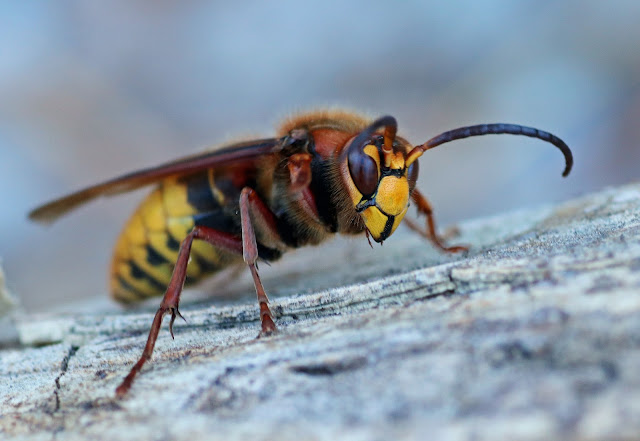
I used the pictures I took to identify it as a European hornet. These are the only true hornet in the United States (except for one more that has recently
showed up on the landscape of our country, but more on that in a bit). They may
reach lengths up to an inch or a little more in the case of the queen. Their
head is red and yellow, thorax brown and red, and the abdomen is striped with
brown and yellow. They are a strikingly beautiful wasp. They sometimes are
referred to as the brown hornet or giant hornet and were first introduced into
the United States in 1840 via cargo containers from Europe. Since then, they
have established themselves all throughout the Eastern United States and are
locally common where they occur. Like many non-native species that show up in
our country, they are eventually considered naturalized. Examples would be the
honeybee, Virginia opossum and the nine-banded armadillo. However, the list
definitely does not end there.
The common name of giant hornet (mentioned above) that is
sometimes attributed to them is a bit of a misnomer. While they are large for a
wasp, the true giant hornet is from Japan and adjacent countries. These
monstrously large hornets are the largest hornet in the world and with lengths
up to 2 inches or more and a wingspan of 3 inches it is easy to see why! The northern giant hornet (formerly referred
to as the Asian giant hornet) or as it is also referred to, albeit not so
affectionately, as the murder hornet…. has recently made an appearance in the
United States. I’m sure this moniker bestowed upon this very much unwelcome
hornet comes from the aggressive temperament and ¼ long stinger! In 2019 it was found in British Columbia, and
by 2020 was sighted in Washington state, and in 2022 a nest was located and
destroyed. This has prompted all sorts of worries of an invasion, not to
mention misidentifications. Any large, brown, and yellow wasp-like creature
must be a murder hornet. This is simply not true. While European hornets
resemble giant hornets, they have a much better disposition and are not likely
to ever cause the problems its much larger cousin can and probably will. Giant
hornets form massive hives and feed their offspring almost exclusively on
honeybees. The USDA and other governmental organizations as well as many local
(to where they were found) organizations are working diligently to keep tabs on
the spread of this potential new invasive species.
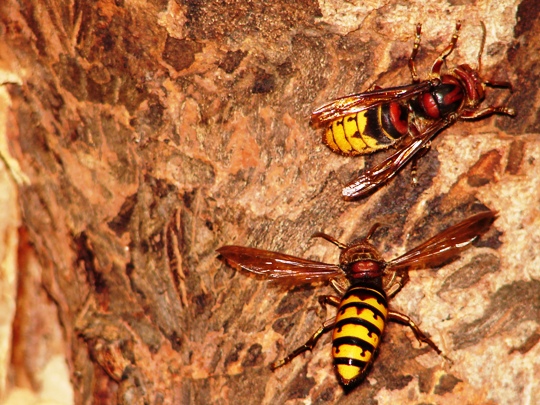 |
Photo By: Steve Scott
|
The European hornet is rarely aggressive and usually
only defensive if mishandled or when the nest is disturbed. We know eusocial
insects, like hornets, paper wasps and yellow jackets can and do defend their
nests with vigor, as anyone who has been unfortunate enough to get close enough
has found out. While this behavior can seem aggressive, it truly is defensive.
They are protecting their queen, her offspring, their food stores, and each
other. There is a lot at stake, and they don’t tolerate potential invaders.
Many social insects use pheromones to send messages throughout the hive, but in
the case of the European hornet, it is now believed they use a different form
of communication. When notifying their fellow workers that danger is nearby,
they perform a dance outside the hive that alerts their hive mates to an
approaching threat. In no time you may have numerous hornets all descending
upon you at once determined to remove you from the area by the only means
available to them, the stinger.
Like all social insects there is a hierarchy that
determines their job within the hive. Bred European hornet females spend the
winter under leaf litter, or within fallen logs and other sheltered areas. In
the spring they become active and start looking for a place to begin nest
building. She wants to find a secluded, dark location, such as a hollow tree,
inside a barn or maybe an attic or within the walls of a house. She will chew
bits of wood mixed with saliva. The saliva acts as a cement effectively gluing
the hive cells together. In the event they cannot find a suitable location that
meets their requirement for darkness and safety they will form an “envelope”
around the outside of the nest. This is similar to the outer covering of a
bald-faced hornet nest. This envelope will protect the nest from light, as well
as wind and rain. Once the queen has raised a few workers they will begin
taking over the care of the queen, the queens offspring, and growing the hive. It
is at this time their unique communication capabilities are put to use in
another fashion called policing. Workers are capable of laying eggs that turn
into males. Other workers of the hive will destroy those eggs and will often discriminate
against those workers who dare lay eggs in the queens territory. By the end of
the season there may be between 200-400 members within the hive. Some larger
hives contain 1,000 or more hornets in various stages of development. In late
summer or early fall the queen will lay eggs that will become fertile males and
females. Once these reproductive adults mate and cold weather sets in the
workers remaining in the hive die off, and newly bred queens overwinter and
start the cycle all over the following year.

In the spring they are active hunters and put their
energy into finding food necessary to grow the larvae. They do this by
providing masticated bits of insects to the young larvae developing within the
nest. Typically, they chose large insects such as cicadas (like I witnessed),
other wasps and grasshoppers. In the fall their diet changes and they become
more scavenger-like in nature. You will find the adults feasting on fallen
apples, pears, and other fruit. These wasps will quickly become inebriated by
the fermentation created within the fruit. This intoxicating libation will have
them stumbling like a drunken sailor. Like yellow jackets, they are also
attracted to garbage left behind by humans as well as soft drinks, and other
sugary treats we favor. This can cause human, hornet conflicts. Most humans,
when faced with a large insect packing a hypodermic needle attached to its
backside, contort into all sorts of odd positions, and begin swatting at the
air like they just don’t care.
Trust me,
when I say this will most likely earn you a sting. Ignore the hornet and
chances are everything will be fine. Just check your pop can before you take a
sip.
While large stinging insects are rarely favored among
humans, we must learn to appreciate the good they provide. In the case of the European hornet, by
feeding potentially injurious insects like grasshoppers, moths, and crickets to
the larvae within the hive, they are providing invaluable pest control. This
can, and does save the agricultural industry millions annually. They are not
known to be aggressive so conflicts should be minimal and learning to respect
the boundaries of their nest will allow for co-existence.


