Sunday, May 29, 2022

Mayapple


“The green umbrellas are blooming.” cheered the children of long ago as they ventured into the nearby woodlands. The unfurling of the green umbrellas, American mandrake, hog apple, raccoon berry, love apple, witches’ umbrella, or wild lemon for many signifies the return of spring. By whatever name you refer to it as the May Apple is a unique and arguably dangerous plant.


“Down in the shady woodland where fern-fronds are uncurled, A host of green umbrellas are swiftly now unfurled. Do they shelter fairy people from sudden pelting showers? Or are the leaves but sunshades to shield the waxen flowers?” Minnie Curtis Wait (1901)

Their scientific name of the Mayapple is Podophyllum peltatum. Podas, Greek for “foot.” and phyllon meaning “leaf” translating into “leaf-footed” and the species name of pelatum translates into “shield-shaped.” All are apt descriptions of the shape of this wildflower. The green shoots begin appearing in March throughout their range in Eastern North America, and by May the flower buds are present and will generally bloom by the end of May or first of June depending upon the weather and temperatures.

They are capable of living many generations and all plants in a given area begin from a single root and spread by rhizomes underground reaching out in, often times, large colonies. Even though there may be many individual plants spreading out over a large area, they are attached to a single root system making them in essence a single plant. The female, or fruit bearing, individual will have two branching leaves with a bud forming in the “V’ of the two stems. The male plant has a single stem and leaf. It takes two years for them to form buds and fruit. The leaves of the May apple do not unfurl until their stem height reaches between 8 to 12 inches. A single white, cream or pink flower will bloom below the protective umbrella of the leaf, this flower will later produce a single lemon shape fruit, that when completely ripe is edible. The fruit should be yellow in color and soft when ripe, DO NOT eat if still green or hard. All parts of the plant are toxic and can cause severe illness and even death to individuals within a twenty-four-hour period. The mature fully ripened fruit is reported by many to taste similar to lemon only not as tart. The fruit may also be brought into your home to perfume a room with the essence of lemon. 


Native nations knew the dangers as well as the benefits of this plant. The root was ground, powdered, and used to treat a vast number of maladies including liver issues. It was also used as a type of insecticide and may still be used today with extreme caution. The insecticide created with this plant is reported to repel insect pests of potato, and corn plants, but should never be applied to any part of a plant you plan to consume. The Shawnee used the boiled root as a laxative and as a topical ointment to remove warts.

Who has ever heard of “Carters Little Liver Pills?” It was pedaled at the turn of the 20th century as a cure for constipation and as a liver cleanse. It has since been banned by the FDA and recognized as dangerous because of the toxic properties of the may apple root which it contained. There are however properties contained within the plant that are known to stop cell division, therefore there are two well-known cancer treatment drugs on the market that contain may apple derivatives and are helping people combat an often-deadly disease. Many herbalists avoid using this plant simply because great caution needs to be used when doing so. It would be too easy to poison yourself or someone else if great care is not used. 
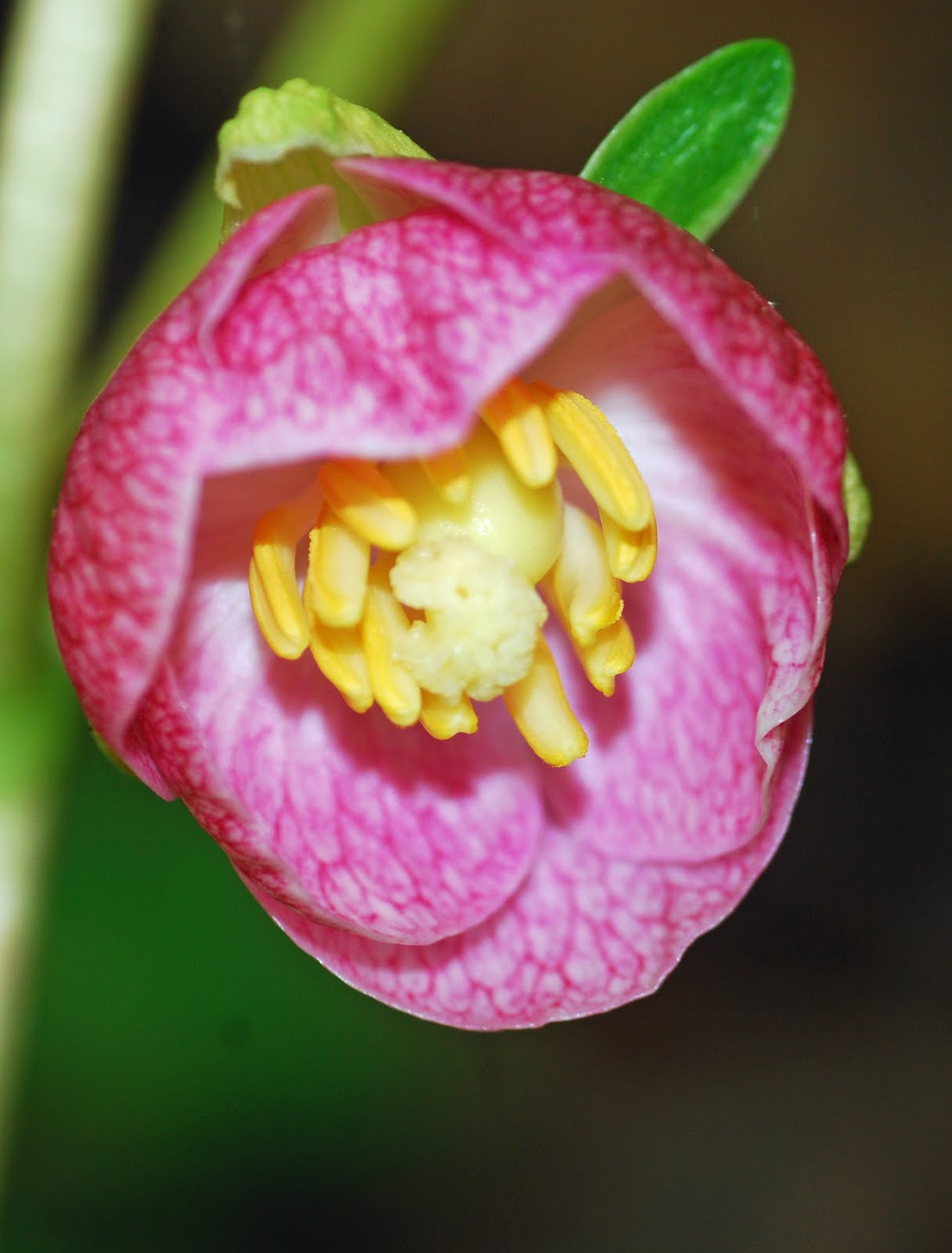
There are four species of Mayapple found in the World, three are in Asia and the one in Eastern North America. It is believed the one we are familiar with came across the Bering Srait with human travelers. It has since established itself as a recognized native to our woodlands. They may also be found growing at meadow edges, along damp roadsides and along riverbanks. They are easy to grow provided they have ample shade, drainage, and somewhat moist environment, although it is reported they can tolerate a bit of drought conditions. They have a tendency to crowd out any other delicate wildflower they share an area with once they are fully established. The foliage is avoided by wildlife because of its toxic properties, and it tastes extremely bitter. When the fruit ripens many animals consume the berry including squirrels, deer, raccoons, skunks, and box turtles. Scientific studies have shown that in areas where the seeds pass through the box turtles’ intestinal tract they germinate more readily. The blooms do not produce nectar, but they do produce copious amounts of pollen and attract bumblebees, long-tongued bees and various other insects that favor pollen. 


Mountain legend has it that a girl pulling the Mayapple up from the root will surely become pregnant. This superstition probably comes from the belief that the mandrake helps with fertility and the Mayapple is often confused with the mandrake and is even referred to as the American Mandrake by mountain people. Mayapples are similar in appearance but should be considered a completely different plant.

No trip to the woodlands would be complete without the presence of the unique and beautiful Mayapple. They are indicators of a healthy ecosystem, harbingers of spring and signify the upcoming morel mushroom harvest. Just remember “look but don’t touch” when it comes to this charming wildflower.

Thursday, February 17, 2022

Blanding's Turtle


One of the most critically imperiled turtles to be found in North America is the Blanding’s Turtle, named for William Blanding (1773-1857), a Philadelphia naturalist who first described it. They are found from Ontario, Canada, south to Iowa and back east as far as New York. The highest population densities are found in the Great Lakes region. They are listed as state endangered or a species of special concern in nearly every state, they occur. The biggest threat these turtles face is the loss of habitat due to agriculture and from major modifications to streams and rivers, such as dam building. Blanding’s turtles have specific habitat requirements that include marshes, sloughs, ponds, lakes, streams, creeks, and vernal pools with shallow water, soft bottoms, and large amounts of aquatic vegetation. With the draining of these wetlands for agriculture and other human endeavors the turtle finds it harder to survive. Added problems this turtle face are vehicles, and predators such as raccoons, foxes, skunks, and even ants feeding on their eggs. Then we must consider that this species reaches reproductive maturity later than most turtles with females being ready to reproduce at about 14 years of age, and males at 12 years of age. With all these things combined we can begin to understand how this turtle has suffered such dramatic population declines.

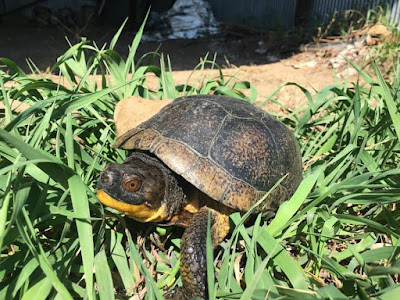
Blanding’s turtles are semi-aquatic basking turtles that can be found either in their watery habitats or on land. Typically, they will leave water when seeking new areas to inhabit or when looking for places to lay their eggs. In the water they are actually poor to average swimmers and will use the dense aquatic vegetation to support themselves as they move through the water. They are often found floating among the aquatic plants or basking on logs, muskrat mounds and other objects within the water. Blanding’s turtles are medium to large turtles with a shell length from 5 to 7 inches, although lengths up to ten inches have been reported. Males are larger than females.  These turtles are often mistaken for box turtles because of their high domed shells, and their hinged bottom shell. 

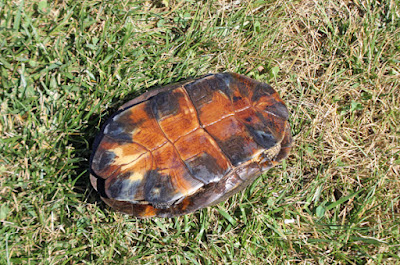
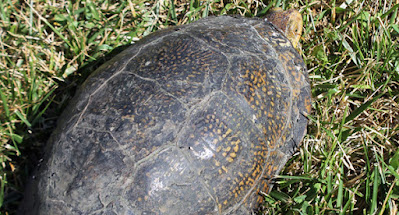
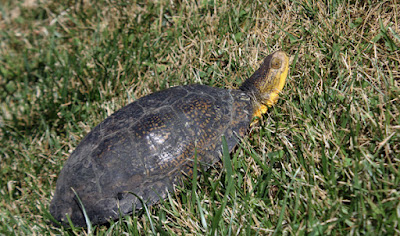
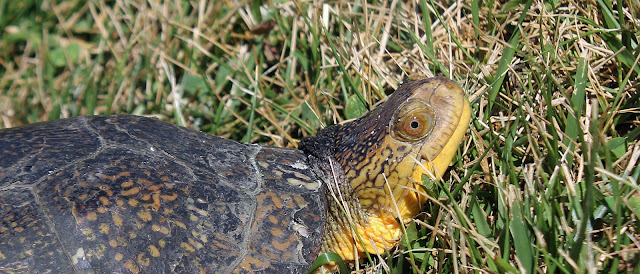
 Their shell is typically dark in color and may vary from gray to black with small light color spots or lines in a highly variable pattern. The bottom shell is yellow with dark blotches. The most distinctive characteristic of this species is the yellow chin and neck. This feature makes identifying them easy as

no other turtle in North America has this bright yellow neck and chin. They often look as if they are smiling, which in my opinion gives them an adorable, charming appearance. This species also has an extremely long neck and are often referred to as long-neck turtles and are lumped in with another long-neck turtle called the Chicken Turtle which is critically endangered in much of its range. Even though they share the same long-necked characteristic as the chicken turtle they are not particularly closely related.

After mating, the female will lay eggs in a shallow burrow. The eggs hatch in about eighty days and the young will head towards the nearest water source. The biggest threat to these turtle eggs is predators such as raccoons, and foxes. As many as 84% of the eggs laid by the Blanding’s turtles may fall victim to predation. Ants can also destroy a batch of newly laid eggs, as well small burrowing rodents like chipmunks. Once the eggs hatch, they are still not out of danger from predation, as foxes, raccoons, skunks, opossums, and large birds like herons and crows all savor baby turtles. Females traveling on land often cross roadways to seek suitable nesting sites and are hit by careless drivers. This takes a devastating toll on the future success of this species. Even a loss of 1 to 2 percent of adult turtles can have long lasting impacts on future generations.  

It is common for this species to live more than 50 years and there are reports of specimens exceeding seventy years. Their reproductive cycle does not slow down with age; in fact, quite the opposite is true. The older, more mature females produce larger clutches and are likely to reproduce more frequently. The ability of this turtle to live to a ripe old age and to continue to reproduce throughout its life may be the only thing that ultimately saves them as a species.

In Missouri there are only a few populations in three counties in the entire state. One of those locations is Loess Bluffs NWR in Holt County. A female was found crossing the roadway near one of the wetlands. It was captured, and a transmitter was secured to its shell. This is the first Blanding’s to be tagged in over 25 years on the refuge. Since then, several others have been located and fitted with transmitters. Volunteers, students, refuges workers and local professors all spend time tracking these turtles and documenting their activities. Much can be learned by diligently tracking these individual turtles, information that may lead to break-throughs to help grow their populations.


The diet of the Blanding’s is varied and includes crawdads, fish, frogs, tadpoles, leeches, insects, and some aquatic vegetation. In most of the range crawdads seems to make up the bulk of their diet. Blanding’s, like all turtles that occur in colder climates, must hibernate during the winter. They will submerge themselves in the water and lay dormant on the bottom in the mud and silt. Their heart rate slows down, and their bodies become inactive as they wait out the wintry weather. In Missouri they may become active again with the first thaw as early as March.

Much consideration should be given before land development takes place in areas where known populations of these turtles are located. Some areas have had success with artificial habitats in helping secure areas for this turtle to reproduce and live. As nearly all states provide some sort of protection for this species, anyone planning to alter these habitats should be made responsible for creating alternate areas for these turtles to live.  


Monday, November 8, 2021

Partridge Pea, Beneficial to Bees and Butterflies Alike

 Partridge Pea, also referred to as the sleeping plant, is a common legume (member of the bean family) in Missouri and much of the eastern United States. It is found in a wide variety of habitats, including savanna, glades, and along riverbanks but also does well in poor soil such as road banks, ditches, abandoned fields and heavily grazed pastures. 

Occasionally partridge pea is purposely planted to aid in road bank erosion, as it grows rapidly and spreads profusely. This plant is insect pollinated by long tongued bees, such as minor bees, bumble bees, honeybees, and large leaf-cutting bees. Honeybees often rely on this plant in areas where appropriate nectar plants are scarce. The nectar flow of this plant is not produced in, or reached by means of the yellow flower, but instead, is accessed through an orange gland at the base of the leaves. In many areas this plant is planted in recognition of their important nectar content. Sometimes leaf-cutter bees will portion off parts of the petals to provision their brood nest with. Three Sulphur butterflies use this plant for their host. You will likely find Little Sulphur, Sleepy Orange and Cloudless Sulphur caterpillars feasting on the foliage.

Bobwhite quail, greater prairie chickens, pheasants and other grassland birds feed on the seed of this plant, the seeds are viable throughout the winter, so therefore they are an important part of these birds’ diet. Because of this plants tendency to grow in thick clumps, young birds, not yet experienced with the risk of predators utilize the thick foliage of this plant as means to hide and camouflage themselves.

Partridge Pea begins blooming in mid to late summer and blooms until the first frost. With sufficient moisture it will retain flowers throughout this entire time. The blooms are somewhat sensitive and will partially close when touched or disturbed. If you raise cattle, be careful, this plant is toxic to cattle. The plant contains a cathartic substance that when consumed in substantial quantities can be stressful to cows and has the potential to ultimately cause death. They like the flavor of this plant, and they will readily consume it. It would be best to not grow this plant near livestock. Although classified as an annual, this plant readily reseeds itself. In areas where this plant is readily pollinated it will produce large amounts of seeds. These seeds are consumed by birds and later dropped in their waste in areas where cows feed. In certain areas ranchers and livestock growers will have to be vigilant and remove plants. In other agricultural settings, away from cattle, this plant has the benefit of adding nitrogen to the soil and makes an excellent cover crop. This plant is also known to attract natural predators of the insects and pests you do not want feeding on your crop. Therefore planting, or encouraging the natural spread of partridge pea around the edges of crop fields goes a long way toward natural insect pest control


Many Native American tribes recognized the benefit of this species of plant and used it in natural healing, the Seminoles used it to treat nausea. It was also used as a laxative but considering the plants toxic properties I would imagine the treatment was worse than the ailment! The Cherokee used it as a stimulant to ward off fainting spells as well as to keep sports players from tiring out. Those of us who like to "grow native" utilize this beautiful plant within our gardens. It is easy to grow, has beautiful yellow flowers and showy feathery leaves. It loves full sun and is drought tolerant which we know is hugely important in Missouri, when we have no idea if the summer rains will come or not. This plant readily attracts bees, butterflies, and birds, which is a bonus to us nature lovers.