Tuesday, May 1, 2018
Hairy Rove Beetle
These beetles would be difficult to mistake for any other beetle, even within their own family. They are large by rove beetle standards at 12-23 mm (1/2"-1 1/4") in length. The body is black and covered in creamy-gray or yellowish hair-like setae. Their head and pronotum (area behind the head) are shiny black. Like most rove beetles they have shortened wings that leave the segments of the abdomen exposed. Despite the shortened wings they are strong fliers. They are also rapid runners. They will virtually disappear under a carcass as their flattened bodies allow them to shinny under a body in record time. If you find one and place it away from the carcass it will skitter away quickly and disappear in nearby grasses or other hiding spots.
These beetles overwinter in the adult stage and become active as early as February and remain active until October. After mating the female will lay eggs on a carcass that usually hatch in three days, although this is temperature dependent. If it is warm outside expect the three days (or even less) but if the temperatures drop it could take days longer. The larvae feed on the maggots of flies and as well as other insect larva. The adults also feed on maggots as well as other arthropods.
Maggots may seem like an unsavory food choice, but a gut loaded maggot is packed with valuable nutrients. These beetles are also helping control fly populations which is helpful to humans. These beetles are also used in forensics to help determine the amount of time a body has been dead and exposed to the elements. There is some debate however as to how reliable they are as an investigative tool. These beetles show up as soon as maggots are available, but will continue to hang around for as long as it takes for the body to decompose. So this particular species may not be as helpful as other species when solving crimes of murder.
When severely harassed or threatened adults secrete an offensive chemical fluid that repels other insects, especially ants. This is a great way for the beetle to chase competition away from a food source. I didn't notice a smelly chemical cocktail from this beetle, but the overwhelming smell of rotting flesh coming from it was probably overshadowing any other odoriferous smell emanating from it. Another defensive trick up their 6 little legs is to roll into a ball, much like a pill bug. Their hard exoskelton protects them from many insect predators that might try to feed on them. If you are rolled into a nice tight ball like an armadillo you are protecting your delicate underside from biting insects. Some people claim they have a sharp bite, and with large mandibles like they possess, it would be easy to see how they would. Still other sources claim they do not bite. My experience with this particular beetle was a positive one, even though I handled her numerous times.
Wednesday, April 4, 2018
Common Eastern Bumblebee
Easily recognized by their furry black and yellow bodies, these large (up to 1 inch) bees are one of the first bees spotted in early spring. Because of their ability to withstand much colder temperature than other insects it isn't uncommon to see them on sunny days in the upper 40's or 50's. Many species of bumblebees cannot fly unless their flight muscles are at least 80 degrees. They have developed several adaptations allowing them to accomplish this even in colder weather. On bright spring days they will find a sunny spot to bask, much like a snake would do, soaking up the suns rays until they are warm. They can also disengage their flight muscles, giving them the ability to vibrate those muscles without flapping their wings. By doing this they can elevate the temperature of those muscles allowing them to fly.
Bumblebees, unlike honey bees do not gather nectar and pollen for future storage. Because they create new colonies each year there is no need to store food, instead all food gathered by the workers is to feed themselves, the queen and the offspring of the queen. A large colony of bumblebees would be around 150 bees, although some overly productive colonies may have up to 1,000 individuals living in it.
Honey bees are easily the most popular of all the pollinators, and this is largely due to the agricultural industry promoting their value to crop pollination. While there is no denying they are hugely valuable for the pollinating service they provide, they are long lived and easily transported to various locations, they however come in second to the pollinating abilities of the Humble Bumble Bee.
Bumble bees are stronger, faster fliers and are capable of visiting more flowers per minute than the HB. Because of their tolerance of colder temperatures they are able to be active pollinating on days that may keep HB's grounded. Bumble bees also have longer tongues than HB which allows them to reach deep into the long throats of tubular flowers. BB's also have much larger pollen sacks than HB's which means they can carry more pollen from flower to flower in a much more efficient manner than their distant cousins.
Even though bumble bees are excellent pollinators and should be encouraged in our backyard gardens or agricultural areas, it is hard to convince those that are afraid or allergic to bees to do so. It is easy to understand why, allergic reactions are nothing to mess with and can be life threatening. Even if you aren't allergic, a sting from one of these bees is painful!! Unlike honey bees which can sting once before dying for their efforts, bumble bees can sting numerous times. They are known to follow a potential predator for long distances chasing the threat away from the hive. My husband found this out when he was in his teen years. While working around a small farm his parents owned they inadvertently disturbed a bumble bee hive and dozens of worker bees were chasing them and stinging them before they knew what was happening. My husband took a sting right between the eyes that swelled his eyes shut. A few years later while riding his motorcycle a bumble bee made it's way into his shirt and stung him 5 times before he could finally kill it by hitting himself in the chest in the general direction of where he could feel the bee moving around and drilling him with an oversized stinger inside his shirt. Needless to say he has a love/hate relationship with all bees.....mostly hate. While foraging on plants they are generally harmless and only sting if provoked. If you start swatting at them, it will most likely earn you a sting, and rightfully so. Their first instinct is going to be to protect themselves, and they will do this the only way they know how.

Sometimes when I am working in the garden and I get too close to one of these busy little bees they will raise a leg at me, and while it looks like they are greeting me with a friendly wave. This little leg wave is actually a warning that I am too close and making them nervous. I move way giving them space and we all get along just fine.
Several years ago while visiting a local conservation area we noticed honey bees and bumble bees both visiting flowers.... looking for any nectar available so late in the season; which happened to be thistle blooms. The much smaller honey bees would fly toward the bumble bees and bounce off them with their legs and bite at them with their mandibles. They kept bombing the Bombus over and over trying to claim the flowers for their own. The bumble bees were no more bothered by their actions than we humans are when swatting at a pesky gnat. The bumble bees seemed to know they were large and in charge and couldn't care less that the honey bees were trying to bully them.Prior to 1920 bumble bees were called humble bees and it is assumed they earned this name from the humming sound their wings make when buzzing around. After 1920 a few scientists who wrote articles in scientific magazines called them bumble bees and the name stuck. They have been called bumble bees ever since. I personally wish they were still called Humble Bees, especially given the fact that honey bees are getting all the love these days, and they are often overlooked. They humbly work in our gardens and agricultural fields often being passed over in favor of a non-native bee with better PR.
Tuesday, February 20, 2018
Red Oak Borer
1.) Japanese Beetles
2.) Asian Longhorn Beetles
3.) Multi-Colored Asian Lady Beetles
4.) Emerald Ash Borer
All of these species cause damage, each in their own way and nearly all were accidentally brought to our Country. Some showed up in shipments of plants from Asia, and others were purposely brought here to control native species that "scientific specialists" felt needed a more specialized predator to control, since in their opinion our own were not doing a good enough job....i.e. the Multi-Colored Asian Lady Beetle. This ladybug-like beetle was brought here to control aphids in forests, several attempts to release it into the wild beginning around 1916 were not successful. Eventually populations of them showed up in shipments of plants in a greenhouse in PA and some escaped. For whatever reason conditions were perfect and they were able to establish themselves and spread westward. The rest is, as we would say, history.
Sometimes for unknown reasons a native species becomes a problem, and such is the case with the Red Oak Borer (Enaphalodes rufulus). The ROB is native to the Eastern United States and parts of Texas and feed on oak trees, especially red oaks (Although they will sometimes jump ship, so to speak, and feed on maple and hickory trees). Up until about 2005 they were a minor pest in oak timbers, but something flipped the switch with these longhorn beetles, their numbers increased significantly, and suddenly they were wrecking havoc on oak forests throughout Southern Missouri, and Northern Arkansas as well as other areas throughout their range.
Red Oak Borers are fairly large beetles in the longhorn family that may reach lengths up to 28 mm (1 1/4 inches). The males have antennae twice as long as their body, females have shorter antennae that are about the same length as their bodies. Overall they are reddish-brown and covered in golden scales, called Setae. These scales are often rubbed off leaving patches of reddish-brown showing. This gives them a mottled appearance. This coloration gives them perfect camouflage which allows them to blend into the bark of the trees they favor. It is easy to pass them by without ever seeing them.

After two years their lifecycle is complete and they will begin emerging sometime in May (or June) depending upon where they live. Their emergence typically takes place at night and they are often found at porch lights or other light sources. While they do have a lot of natural predators, including woodpeckers, that use their long beak to locate them under the bark of trees, also sap beetles, ants and carpenter worm larvae all enjoy a tasty red oak borer grub for a meal. Even though many thousands of grubs are killed this way, and estimates are that 15% will survive to adulthood, it doesn't seem to affect their numbers in any real significant way.
Adult beetles exit the tree via a 1/2 inch hole they have bored into the tree to the outside world. It may take 2 years for wounds left by these beetles to heal, and fortunately death of the trees is rare unless the tree is already weakened or damaged in same way and cannot withstand an onslaught of feeding grubs.
The feeding habits of the grubs cause significant damage to the timber, which is used for lumber. The defects caused by their tunneling makes the wood worthless to markets that would typically demand the highest prices for quality oak boards. This has resulted in millions of dollars in losses to the oak timber industry. It is also not entirely uncommon to have lumber shipped overseas and have beetles emerge from the boards, which creates an invasive species situation in those countries.
I've not been able to locate any information as to why this beetles numbers have increased so exponentially over the past decade or more. Could it be fewer predators feeding on them? Is it an increase in food sources? Is it the irresponsible moving of timber from one area to another, either in the form of firewood, or logs meant for lumber? By whatever means their numbers have increased, it is obvious they are here to stay and will continue their feeding frenzy on oak trees.
Wednesday, January 24, 2018
Stink Bugs
Stink bugs belong in the order Hemiptera and possess piercing-sucking mouthparts called a proboscis, rostrum, or beak. They use this beak to inject enzymes into plants or insects to help break down tissue and allow the stink bug to more easily consume its choice of food. Stink bugs also possess a rather noxious defense from which they get their common name. When threatened by a potential predator or sufficiently harassed, they will emit a foul smelling odor that is designed to deter their attacker and give them a chance to escape. Most likely it is just as simple as this odoriferous concoction just plain tastes terrible and once a would-be predator gets a taste of it it thinks twice. Stink bugs have very few predators. If you've ever smashed a stink bug inside your home or vehicle you will know exactly what I am talking about.
There are 11 different species of stink bugs within the genus Banasa, another one is the Juniper Stink Bug, or Jade Stink Bug (Banasa euchlora). Like their cousin the Banasa Stink Bug they are on the small side at only a few mm in length. What they lack in size they make up for in beauty. They too are widespread throughout much of the United States and are associated with species of junipers. They feed on the juniper berries. Both of these species, like many other stink bugs are attracted to lights at night. I commonly found them at the white sheet and mercury vapor light I put out in the summer months. The Spined Soldier Bug (Podisus maculiventris) is one of the most common stink bugs in our area. They are predators of other insects as you can see pictured right as this one feeds on a Green Dock Beetle. Stink bugs are often the first insects I see in the spring when the weather begins to warm up. Most species spend the winter as adults hiding out in leaf litter, under the bark of trees or other protected areas. The first thing on their mind after waking up from their winter nap is food, but a close second is mating. Many species produce several generations a year. The female will lay a tight cluster of tiny barrel-shaped eggs on the leaves of various plants and trees.
Many species are considered significant pests of agricultural crops and can cause millions in damage each year across all types of crops meant for human consumption. These plants may include corn, soybeans, peaches, pecans, blueberries, grapes, etc.
One less common species is pictured here (above & right), The Lugens Stink Bug (Mormidea lugens) is found in the Caribbean, Central America and North America. It rarely, if ever occurs in large numbers. They are a few mm in length and beautifully colored with a dark bronze tone trimmed in white. Various types of grasses and sedges are their food preference.The Anchor Stink Bug (Stiretrus anchorago) comes in many different color forms, there is an all black variety and also red & black, and white & black. The overall pattern is highly variable as well, but most specimens will have an anchor-like pattern on their abdomen. This medium-sized stink bug feeds on the caterpillars and grubs of butterflies and beetles. Their feeding habits could be considered beneficial to agriculture as they seem to prefer dining on insects that cause significant crop and plant damage including the Mexican Bean Leaf Beetle, Cabbage White Butterfly, the Alfalfa Weevil, the Soybean looper and many others. While their prey preferences makes them helpful in controlling pest populations, they however do not occur in large
enough numbers for them to be considered HUGELY beneficial.
Plus we have to consider that they are actually a generalist predator, meaning they will eat most any insect they can catch. This includes the pest species mentioned above, but may also include those insects we don't mind having around like ladybugs and swallowtail butterflies.
Anchor Stink Bugs, or Anchor Bugs are found throughout the Eastern United States as well as California. You will find them in agricultural areas in the grassy strips next to crop fields. Look for them in open fields and in fence rows as well.
Like all stink bugs they really don't have many predators, but there is a species of tachinid fly that will use this species to deposit it's eggs on. The fly larvae will then feed on the stink bug.
The Green Stink Bug (Chinavia hilaris) is probably the most common stink bug I see here on the farm. They are large at up to 1/2 inch or a little more in length. Body is green with yellowish margins.
They feed on a wide variety of plants and seem to develop a taste for the seeds. Tomato, bean, pea, cotton, corn, soybean, eggplant are some of the preferred plants they may becomes pests of. If seeds are not available they will feed on stems and leaves and may damage a variety of fruit trees including plums, peaches and apples. They often congregate in large numbers on the sides of trees in autumn. The larvae of this species (above left) is beautifully colored and easily identified.
This tiny stink bug is the Twice-Stabbed Stink Bug (Cosmopepla lintneriana). Their common name comes from the two bright red "stab marks" on their wings. They are also referred to as the Wee Harlequin Bug, or Two-spotted Stink Bug. They are found throughout Eastern North America. I do not see them very often, but this may be because of their diminutive size and at 4 to 6 mm they are tiny. Females overwinter in leaf litter and mate in the spring. She will lay eggs in clusters on plants and guard them until they hatch.
The Brown Stink Bug (Euschistus servus) is found mostly throughout the Eastern United States but there are scattered populations in the Northern part of the country. They are extreme generalist when it comes to their diet and feed on a wide variety of food, including plants and insects. They are considered to be of economic importance as their extreme appetite for all types of food causes damage to soybean, corn, cotton, alfalfa, sorghum, fruit, pecan, and tobacco a well as others. Adults overwinter in protected areas and become active in early spring and begin feeding. They will mate and second generation offspring will turn their tastes to agricultural crops.
Stink bugs are a class of insects that can be considered both good and bad. While many of them can and do harm agricultural crops, garden produce and orchards, there are equally as many out there that are feeding on pest insects that damage those same crops. These alien-looking insects are interesting and widely studied. I don't really think about them one way or another, but I will say I DO NOT squish them. PEEE EWWW!
Monday, January 8, 2018
Red-Lined Burying Beetle
They are one of approximately 183 beetles included in the Siliphidae family. These are broken into two sub-families called Silphinae and Nicrophorinae. Red-lined Burying beetles are included in the sub-family Siliphinae. These beetles along with other members of this sub-family are studied extensively by Forensic Scientists. Because of their relatively slow development and preference for hanging out on large dead mammals they are a potential goldmine of information to law enforcement in solving crimes of murder.
In the spring adult beetles, which have overwintered in sheltered locations, become active and seek mates near decomposing carcasses that they are able to smell from great distances. Mating will take place on the actual carcass as they crawl in and out of crevices of rotting flesh, or perhaps they will chose a less unsavory location "near" the carcass. Once mated the female will deposit eggs on the ground close to the carcass. It takes up to seven days for the eggs to hatch. Time for egg hatching is temperature and moisture related in most cases. Once hatched the tiny larvae will crawl onto the carcass and begin feeding on carrion and occasionally a wayward maggot (fly larvae) that may get in their way. The adults feed mostly on maggots and occasionally carrion. The feeding habits of the larvae and the adults seem to be in opposition of each other.
Occasionally you will find these beetles acting as transportation to a busload of mites. These mites do not harm the beetles and simply use them as a means of getting from one carcass to another.
The mites will feed on any leftover stinky flesh bits that may be attached to the beetle, in essence cleaning the beetle. They also feed on maggots when on the carcass. The beetle benefits by getting a mites version of a bath, and the mite benefits by being carried to the next carcass.
Carrion Beetles within the Silphidae genus usually choose large mammals for their dinner table. They exhibit little to no parental care. Carrion beetles in the genus Nicrophoridae however, DO exhibit parental care. They typically choose smaller animals such as mice or birds to feed themselves and their offspring. They will bury their food choice in the ground along with themselves and remain there to lay their eggs, and help feed and groom their offspring. Nicrophoridae usually have much faster development from egg to adult than their Silphidae cousins and thus are not as valuable to forensic science.
As you can well imagine these beetles have a foul odor when you happen to get one too close to the old olfactory. Many humans wouldn't dream of picking one up and with good reason (Just think about where they hang out!). The smell they carry with them as part of their everyday perfume is damned difficult to wash off your skin. Not to mentioned they will add an additional dose of chemical defense pheromones when harassed. Being held by a giant (namely me) is all the harassment they need for sharing this odiferous blend of noxious cologne! BLEH!! Suffice it to say...."look but DON'T touch" is a good rule of thumb when it comes to carrion beetles. Beetles within the Siliphidae family have been around for at least 10,500 years, and throughout that time their lifecycle has changed very little. If it's not broke don't fix it seems to be the mantra for these carrion-loving beetles. The body of the Red-lined carrion beetle is distinctly flattened for crawling under and around dead carcasses. They have deeply ridged wings. The color is dull black with a shiny black pronotum (thorax region). There are red or yellow markings on the hind portion of the wings. Occasionally individuals are found with no markings. Males have a unique leg structure. The hind legs have a large tooth on them. These tooth-like leg structures are most likely used during mating. Males also seem to have much longer abdomens which protrude from under the wings.
These beetles are typically nocturnal and may occur in large numbers at certain times of the year. As mentioned above, they are often found at lights at night. They occur throughout Eastern North America (East of the Rockies), portions of the Pacific Northwest and parts of Canada.
While large beetles can be somewhat startling to people who have no love of insects, especially when they are hanging out near your porch light. These beetles are hugely beneficial to humans. Their preference for dead and decaying flesh make them the clean up crew for all things stinky and nasty. They break down tissue into organic matter that is readily absorbed into the soil which helps plants grow. Their feeding habits also remove potentially diseased animals from the environment making it safer for us and other animals. Their value in forensic science is irreplaceable in solving murder cases. They may not at first be very appealing, especially if you happen to catch a whiff of foul odor akin to rotting flesh coming off of one, but keep in mind not all things need to be cute, fluffy and smell good to be beneficial and valuable to us as humans.Thursday, December 14, 2017
Red-Spotted Purple Butterfly
One of the most magnificent woodland butterflies to call Missouri home is the Red-Spotted Purple (Limenitis arthemis). They are now considered to be the same species as the White Admiral (Limenitis arthemis) and occur throughout the Eastern United States. The species name of "arthemis" comes from the Greek Goddess of the same name, she was the Goddess of the hunt and the wild. Occurring in woodlands, woodland edges and suburban areas they are a fairly common sight to see in mid-summer through fall. Spotting a flash of bright blue as it wings past you to some unknown destination up ahead is sure to grab your attention.
Historically it was believed that the Red-Spotted Purple and the White Admiral were entirely separate species, but after DNA testing and much laboratory research by individuals who do that sort of thing, it was determined they are the same species. The RSP has iridescent blue or blue-green upperwings, and a dark brown underside. The forewings have two reddish-orange lines near the base of the leading edge; the hindwing has a series of reddish-orange spots marginally and sub-marginally. There is a lot of speculation as to why this species was named Red-Spotted PURPLE, when clearly the wing are bright blue or blue-green.....perhaps the person(s) who were responsible were color-blind?
The WA has a black upperside with broad white bands on both wings. The underside is reddish-brown with white bands that match the upperwings. The wingspan of both species is considered large and may reach up to 4 inches. Males and females look identical, but females are typically larger.
The White Admiral is almost entirely a Northern species whereas the Red-Spotted Purple occurs in the Midwest and upper Midwest. I have never seen a WA and consequently do not have any images of them.
Where their populations overlap it is common for them to interbreed creating various hybrid subspecies that are healthy and capable of reproducing. There are at this time 25 known subspecies in the tribe Limenitidini and they are typically grouped by region. Butterflies in this tribe are often named after military ranks, most likely due to their relatively large size, flight patterns and brilliant colors. When scientists and researchers were naming these butterflies the light colored stripes on many of the various subspecies wings reminded them of the epaulets worn by admirals and commodores.
![]() |
| Viceroy |
I would love to see the hybridized offspring of these butterflies though, it would have to be unique and beautiful.
![]() |
| Pipevine Swallowtail |
| Red-Spotted Purple |
Wednesday, December 6, 2017
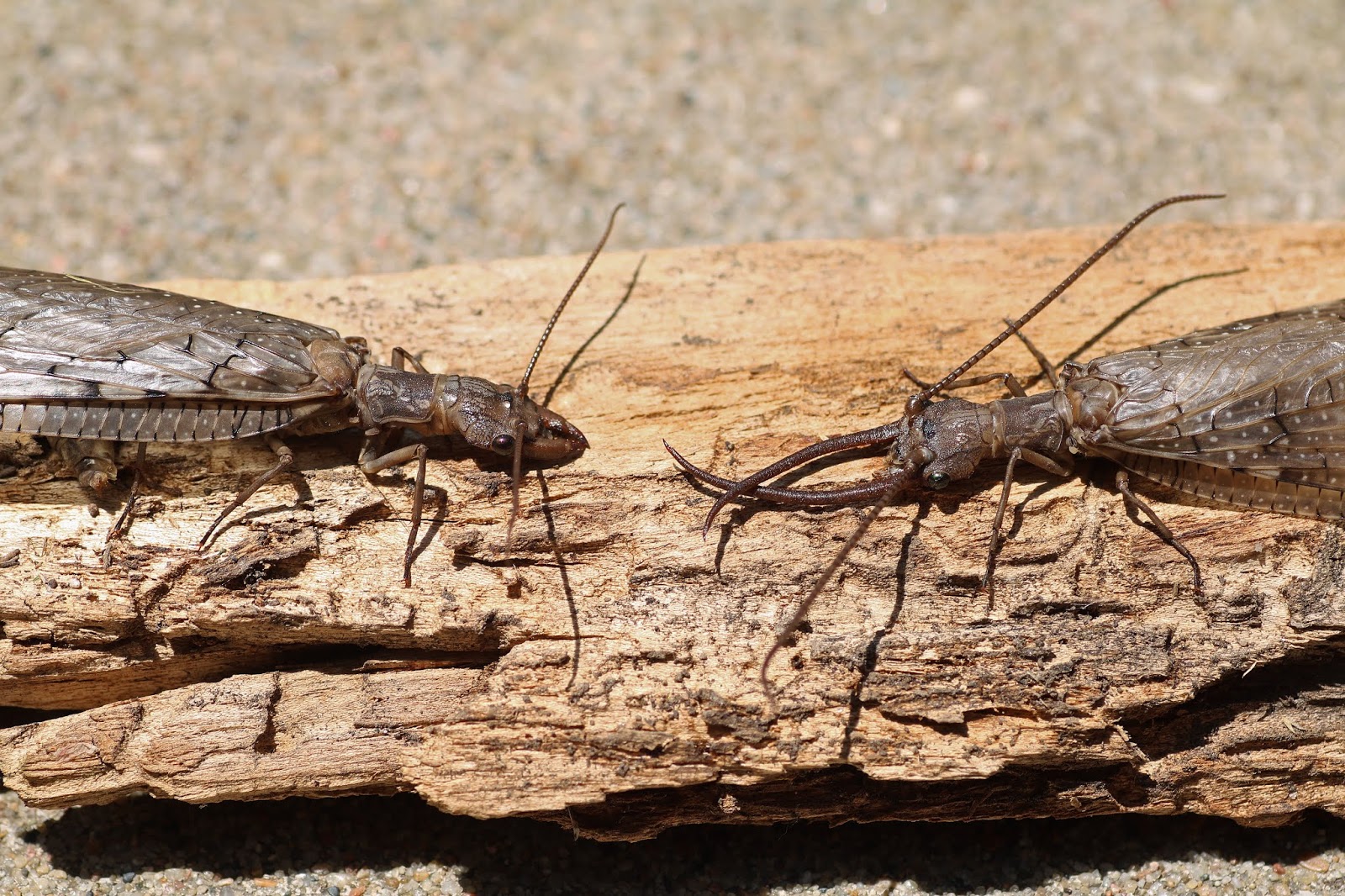
Eastern Dobsonfly
Eastern Dobsonflies (Corydalus cornutus)
look like something out of someones nightmare. They are large,
alien-looking, and downright intimidating in their appearance. They
measure well over three inches in length and with those sickle-like
mandibles, the males are often 4 inches or more. Females lack the longer
mandibles, but possess a painful bite when harassed. The larger
mandibles of the male lack bite force and are most likely used to
impress the ladies or to fight off potential competition from rival
males. Some resources claim the males use those mandibles to flip rival
males onto their back in a form of combat to win the affection of a
nearby female. Apparently these WWE
wrestling matches between males weed out the weaker individuals and the
stronger, more capable males will mate and have their genetics carried
into the next generation.
After mating, females will
form egg masses on vegetation near a water source, usually a moving
stream or small river. These egg masses are often clustered together as
several females will use the same location to lay their eggs, in a type
of Dobsonfly rookery. The eggs hatch and the nymphs, called Hellgrammites
must find their way to water. Whether they just gracefully fall into
the water or crawl their way there is dependent upon how far away from
the water the egg mass was formed. Often this can be quite a distance,
so dropping into the water would not be an option for those individuals,
instead they will have to hoof it to the nearest water source and hope
hungry predators don't find them along the way.
Once Hellgrammites have had time to grow and reach their full larval size, usually after 12 molts or skin sheds, they will leave the water and look for a place on land to burrow into loose soil where they will create a pupal cell. Once buried and safely ensconced in this chamber they will remain here for 7 to 14 days as they pupate into adult Dobsonflies. When the adults emerge they will begin looking for mates to pass on their genetics to the next generation. Males live about three or four days, females live up to ten days.
In Virginia and Pennsylvania the emergence of the Hellgrammites from their watery homes seems to be synchronous. A mass exodus of these little hell-beasts is usually triggered by a large thunderstorm; it is believed that the vibrations of the thunder acts as some sort of signal to the Hellgrammites to leave the water and head for land. As the larvae crawl out of the watery depths the locals call this phenomena "Hellgrammite Crawling," not to be mistaken for pub crawling.
It is uncommon to find adults during the day as they hide out in vegetation near the water. At night they are attracted to lights and are commonly found at porch lights and other night time light sources. They have also been found to be attracted to Mercaptan which is the substance that is added to Natural gas and Propane that gives it the distinct odor we all recognize as a potential leak. This apparent attraction they have to this substance may act as a calling card to the presence of these gasses. They also seem to prefer moderately clean water environments and do not tolerate highly polluted water. This means they can be used as a bio-indicator of potential health problems within watery habitats. If these insects are present it is a good indication the water is healthy and clean, if not, maybe these environments need a closer looking at.
There are 60 species of Dobsonflies in the order Megaloptera, which means "Large wing." Within this order there are 30 species in the genus Corydalus. The Eastern Dobsonfly is the most common and largest within the United States. They occur throughout Eastern North America from Canada to Mexico. There are three species in the Western United States, however the majority of species within this genus occur in South America.
Tuesday, November 21, 2017
Round-Tipped Conehead Katydid
Hearing the word Conehead , for many of us middle-aged folks, brings to mind a classic skit from the older Saturday Night Live episodes by the same name. So popular were these skits they later became a movie starring the original cast members Dan Akyroyd and Jane Curtain. These awkward, friendly aliens did their very best to assimilate into society. As endearing as those lovable aliens were, I am referring to a completely different conehead, this particular conehead IS strange-looking, but not alien.
The round-tipped conehead katydid(Neoconocephalus rotusus) is native to the Eastern United States and found from Eastern Nebraska, to as far north as Massachusetts and south into Florida (but absent from the extreme Southern portion of the state). When you first encounter a conehead, of which there are approximately 22 known species in the United States, you can easily see the resemblance to those silly aliens. Their heads come to a rounded point at the base of the antennae. Some have long points others have short ones. In the case of the round-tipped conehead, they have the smallest of all the "cones" with a black line running through it (visible in the picture below), which is a key identification characteristic of this particular species. These katydid's come in two color forms. The bright green form is the most common, but there is also a less common brown variety.
You will most likely hear one of these katydid's long before you actually see it. They begin calling in late afternoon and continue calling well into the night. They are often difficult to see as they blend in with leaf-like camouflage on the plants they hide among. These are the smallest of North America's Coneheads, measuring 1 1/2 to 2 1/4 inches in length. Their song is not particularly appealing to the ears either, but what they lack in musical ability and size they make up for the looks department. They are subtly pretty with bright green bodies, accented with yellow and bright reddish-pink jaws and yellow leg markings. The brown variety is not near as pretty as their green counterparts, they seem to have been passed by in the looks department.
Their antennae are strikingly long and it these that I usually spot before I actually see the katydid itself. They wave these long antenna, which are loaded with special sensors, around their environment sensing for everything from food to mates. Something called Chemoreceptors, are used to pick up the pheromone scent given off by nearby females, or even other males that may be moving in on their territory after potential mates. They also possess tactile receptors that act like "feelers" which help them navigate their surroundings. Additionally they have a special receptor called the Johnston's Organ, located at the base of the antennae. This organ is used primarily during flight to sense gravity, air speed and even the wing beats of bats.Many studies have been done with this species in relation to bats. It is believed that bats are able to hear the calling of katydids; essentially guiding them to the location of the serenading romeo. To evade predation by a hungry bat the conehead will use strong leg kicks and steering to move away from the echo-location pulses the bat is emitting. They have also been observed taking deep dives to literally drop out of the sky just as the bat swoops into empty space where once there was a tasty katydid meal. We all know bats in the Midwest are insect eaters and we've been taught they can consume 1,000's of mosquito-size insects in a single night. But to consume a large meal such as a katydid would require much less energy than chasing and swooping in on 1,000's of small snack-size insects. Think of it as going to an all-you-can-eat buffet and ordering a salad versus the smorgasbord that awaits you on the buffet. NOT going to happen, unless you possess extreme willpower. Generally speaking we will stuff ourselves instead of grazing.....viola, so does the bat. In late summer or early autumn bats are consuming larger quantities of food to pack on fat to see them through the long winter hibernation. So insects like katydid's or even large moths are definitely on the menu.
Katydid's possess ears on their elbows, or at the base of the first front leg joint. They are bright yellow and visible in the photo below. Called Tympana, these ears are used to pick up the sound of potential mates, and to hear other katydids nearby. Males can be territorial and will chase away potential rivals.
![]() |
| Ovipositor of female |
Mating takes place in late summer or early autumn and the females will use a long bayonet-like projection, called an ovipositor, located at the tip of her abdomen to "inject" eggs into clumps of vegetation. The eggs are safely ensconced inside the stems of various plants, all tucked away from the wrath of winter. Next spring the eggs hatch and the young katydids are born looking much like their adult counterparts. They lack wings and functioning reproductive parts, but as they age, and molt these will soon appear. Often they will eat their shed skin casings for extra protein, but occasionally you will find a ghost-like shed skin hanging from a bush or clump of tall grasses. They feed on a wide variety of grasses and weedy plants in old dry grassy-weedy areas, along roadsides and in old fields. You will also find them at the edges of marshes and in fence rows. Their feeding habits are not known to cause any significant damage to agricultural crops, but they will occasionally feed on garden plants which can be irritating.
We have this particular species in large numbers all around our farm. They even come to the lights at night. I for one look forward to the sound of the katydid as it calls incessantly from the grasses as the sun sets. Truly the sound of a waning summer and the approaching Autumn.