Saturday, September 29, 2012

Black Blister Beetle

This matte black beetle is a Black Blister Beetle (say that fast three times). These beetles are in the family Meloidae. They are quite common around here, especially in the fall. I find them frequently on the goldenrod around our farm. Some plants will have dozens of these beetles on them.Many of them are mating and creating mirror images of themselves for the next generation. With nearly 7500 species of blister beetles found throughout the world there is no shortage of these noxious bugs to be found. 

(This particular beetle seems to have an injury. Not sure what caused it. I can't imagine that anything would chose to feed on these beetles, but perhaps some predators don't mind the nasty taste. Or maybe the predator discovered the noxious taste after biting a wing off and decided that was enough)

 They have an elongated body with a very narrow thorax. This cylindrical shape is very typical of blister beetles. They are commonly found in  vegetable and flower gardens. Look for them near croplands, especially forage crops. The adults feed on a wide variety of foods like clover, alfalfa, soybean, radish, carrot, beans, cabbage. In the wild they will feed on pigweed. They also will feed on ornamental plants like Hostas. The black variety is especially fond of goldenrod. After mating, the females will lay eggs in clusters in the soil. After the larvae hatches it will seek out grasshopper eggs and young grasshopper nymphs that are beginning to surface from underground. Sometimes they will also feed on bee larva. This makes them an important natural control measure for these often time invasive insects. Blister Beetles aren't always the "good guy" however. They have a dark side. Blister beetles contain a chemical in their legs called cantharidin. This chemical is extremely toxic, especially to horses. The horses come in contact with the beetles in their feed. The beetles feed on alfalfa, then the horses also feed on the alfalfa. As few as 550 beetles can kill a young horse weighing 275 pounds. This chemical is also found in the controversial drug called "date rape drug". 


I myself have had a run-in with these beetles. Several summers ago we had 100's of these beetles all over our farm. They were in the gardens, in the flowers beds. They were feeding in large numbers on my hostas, and had nearly defoliated the hostas before the summer was over. At night they were around the pole lights. I also spent a lot of time near the pole lights, looking for bugs to photograph, or capture for my collection. One night I felt one of these beetles land on my neck, as I went to brush it off me it released some of this awful chemical and blistered my skin. This blister hurt for days and left a welt for over a week. These beetles mean business, this is chemical warfare at its finest.

These beetles are best looked at and not touched. They are common and easily found, some years there seems to be more of them, than other years. In the past two years I've not seen populations of them anywhere near like what I had several summers ago

Friday, September 21, 2012

Spotted Cucumber Beetle

Spotted Cucumber Beetles(Diabrotica
undecimpunctata), are small (3 or 4 mm) in size, but bright in color. They superficially resemble ladybugs with those spotted wings, but instead of bright red, pink or orange like ladybugs they are a lemon-lime green. Their head is black as are their legs. Don't let their diminutive size fool you though, these beetles are extremely destructive.They overwinter in leaf litter near fence rows, wood lots and areas near protected buildings. In the spring with the return of warm weather they will become active again. They will seek mates in early spring and the female will lay her eggs in the soil near the base of host plants. When the eggs hatch the young larvae will burrow into the soil to feed on the roots of various plants. It is this activity that has earned them the common name of Southern Rootworm.  After a few weeks they will emerge as adults and it is these grown up beetles you will find in your gardens feeding on the leaves of cucumbers, as well as squash, melons, beans, beets, tomatoes, potatoes, eggplants, cabbage and a host of other garden favorites. 


As adults they prefer to nectar at flowering plants, but will feed on nearly anything they can find. Although it isn't the adults that wreck havoc, it is the wormlike larvae of this beetle that causes so much irritation and expense to farmers and growers everywhere. Their burrowing action damages the root systems of a vast amount of grain crops, especially corn. They are even known vectors of bacterial wilt. Millions each year in crop loss are attributed to these little spotted beetles. There are two other subspecies of this beetle and each are equally problematic to farmers and growers; Western cucumber beetle (Diabrotica undecimpunctata tenell) and the Western spotted cucumber beetle (Diabrotica undecimpunctata undecimpunctata). They aren't typically found in our region, you will instead find them out west as their names indicate. 


As a farmers wife I can sympathize with the farmers in their constant battle to stay one step ahead of an often times unseen enemy. The farmers job is to grow a good healthy crop, and get it to market (hopefully for a profit) so he and his family can make a living. So when these unwelcome visitors make themselves at home in the crops, often times drastic measures have to be taken. All too often this in the form of pesticides. While I am a farmers wife I am far from an advocate of pesticides. All too often they are used in ways that cause more harm than good. Pesticides do not differentiate between helpful insects or harmful insects. So many times the insects that actually benefit us are killed in the line of fire.I will never encourage anyone to use pesticides as I feel the damage they can cause far outweighs the benefits. Often if we will allow mother nature to do her job she will surprise us in many ways. Many other beneficial insects, birds, spiders and other known predators of insects will step up their game and consume the problematic insects. If we spray these chemicals and kill off all our beneficial insects we are defeating our purpose. Approximately 5% of the harmful insects will survive the onslaught of chemicals. These insects will now have a small resistance to the insecticides designed to kill them. They will pass this resistance off to their offspring and within a few generations these harmful insects will have total resistance to the chemicals. Now the chemical companies have to create new insecticides to kill the same insects. We essentially accomplish making the chemical companies richer. Bats, birds and the surviving beneficial bugs will leave your area because it has now become a wasteland of death and there is no longer anything for them to eat.These chemicals leach themselves into our soil and make their way into the water systems, whether that is in the form of ponds, lakes, rivers, or the well water we drink and cook with. What impacts will that have on other wildlife? On humans?


 We have 66 acres of row crops here on our farm. We rotate corn and soybeans each year and we have not used a pesticide, insecticide or fungicide in over 15 years. We have experienced no crop loss due to bugs, because we recognize that there are many insect predators out there taking care of it for us. 

The drought heavily impacted the plants and animals in our region this year. We received early rains, then no rain throughout the summer and some late rain in the past couple of weeks. It seemed to create a perfect situation for these beetles, as I've seen record numbers of these beetles this year. All feeding on the tomatoes and melons in our garden. Thankfully the remaining veggies are not good for human consumption so the bugs can have them.


Monday, August 27, 2012

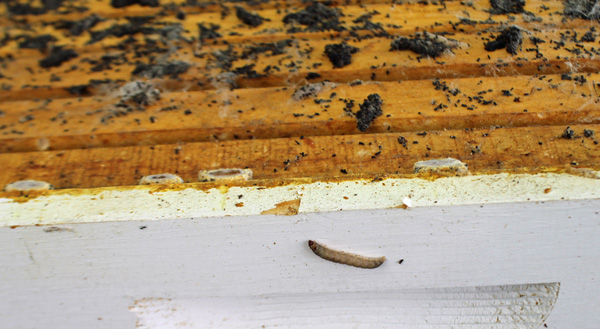
Honey Bees + Wax Worms= Epic Fail

Several week ago I asked a friend of mine, Shannon, to come out and help me open up my hive and see how they were doing. I was concerned as I had noticed an extreme reduction in the number of bees hanging out around the hive. When Shannon arrived we gathered our equipment and headed to the hives. We smoked the larger hive and opened it. I could tell my bees were gone....just gone! I told Shannon, and he said they were out foraging. I knew better. I sit and watch these bees all the time and I know their habits. We began taking the hive apart and discovered a few wax worms. We killed them and removed the damaged comb. As we delved deeper into the hive we found several more wax worms and each one was killed and the contaminated comb removed. We put the hive back together and moved onto the next hive. This hive was young, and wild caught. I've only had it about 6 or 8 weeks. They seemed to be doing well and we saw no evidence of wax worms.
I was still deeply concerned about the older larger hive, but decided to try not to worry too much.

The following week we packed our bags and went to the Smoky Mountains for a family vacation. Eight days later we returned home and I had to plan a large event for work and my time was tied up with last minute details revolving around that event. It was an additional week before I was able to get around to checking on the hive again. To say I got a surprise would be an understatement.  I opened the top on the hive and got a face full of moths. I was so disgusted by what I found, the entire hive was desecrated by wax worms!


Waxworms are the larval stage of the Wax Moth in the family Pyralidae which are the snout moths. There are two species that are often bred for fish bait and are often called waxies by bait shop owners and fishermen. They are favored by fishermen who enjoy catching small game fish like sunfish, but for beekeepers they are a nightmare.  They are a parasite of bees and feed on the honey comb, beeswax, shed skins of bees, pollen and cocoons. They can destroy a weakened beehive in no time. A strong, healthy hive functioning with all members can usually fight off a waxworm threat. A divided hive with no queen is severely weakened and would not be able to deal with a scourge like waxworms. Which is essentially what happened to my hive.

This fall when the weather cools down  I will clean up the mess in the hive and sterilize it. Next spring I will try once again to raise a successful hive. The smaller hive I had I gave to Shannon to hand over to another bee keeper so as not to risk it getting contaminated with waxworms. So hopefully next spring will turn out better.

Saturday, August 18, 2012

Hayhurst Scallopwing

Tonight while outside photographing the insects attracted to the only thing blooming in my yard, the peppermint, I noticed this dark butterfly. I wasn't familiar with it and at first thought it was a sootywing of some sort. I posted this image to facebook and my friend Betsy Betros was able to identify it for me as a hayhurst scallopwing (Staphylus hayhurstii). 

She said this species is fairly easy to tell apart from the other small black butterflies by the wavy, or scalloped wings. These butterflies belong in the family hesperiidae with the skippers . Most skippers are tiny butterflies with upfolded wings when in the resting position. This species is a spread-wing skipper measuring up to 1 1/4 inches and rests like other butterflies with its wings open. They are dark with checkered fringe and tiny transparent spots on their wings. Those spots are visible in this picture as two tiny dots near the corner of the forewing.


Hayhurst scallopwings can be found throughout the eastern portion of the United States as well as in Texas. They occur in a wide variety of habitats including open woodlands, backyards, roadsides, and weedy lots. The adults nectar at most any flower but seem fond of peppermint,marigolds, clover, cucumber and dogbane. 


Males will perch low in vegetation to attract passing females and will mate with receptive females. Eggs will be laid one at a time on the leaves of host plants such as Lambsquarters, in the goosefoot family, and occasionally chaff flower (Alternanthera) in the pigweed family. In Missouri there will be two broods, one in the spring and one in the late summer.
Thanks Betsy for the ID on this subtly beautiful butterfly.

Thursday, July 26, 2012

Seven-Spotted Lady Beetle


Seven-spotted lady beetles (Coccinella septempunctata) are one of the most common ladybugs found in Europe. It was apparently intentionally introduced to the United States on several occasions from 1954 to 1971 to help control aphid populations and each one of these attempts failed. Ironically a successful, accidental introduction was discovered in New Jersey in 1973. They have since established themselves throughout much of North America and often out compete native species of lady beetles for available food sources. In their native home of Europe they are however facing trouble as the non-native Harlequin Ladybird Beetle out competes it.


Even though this insect is not native to North America it has established itself in such a way that it is considered naturalized and many states have adopted it as their state insect, including New Hampshire, Delaware, Tennessee, Pennsylvania, Ohio, and Massachusetts. This species occurs throughout Missouri and is quite common in some locations.

Their bright red color is aposematic in nature and is designed to ward would-be predators that they taste bad. They are able to produce a foul tasting secretion that they emit from their legs. These are large lady beetles and may reach lengths up to 1/4 of an inch. In addition to being a bright red, they have three black spots on each wing and a single spot located on the median line near the back of the head. This gives them a total of seven spots from which they get their common name.


 Reproduction takes place in the spring, females will lay clusters of eggs near aphid colonies. When the eggs hatch the newly born lady beetle larvae will have a ready food supply. It takes them several weeks to reach adulthood.

Even though these insects are not native and do compete with native species for available food, they are beneficial because of their voracious appetite for aphids and other soft bodied insects that will damage your veggies and other garden favorites, not to mention your prized roses.


Tuesday, July 24, 2012

Eastern Tiger Swallowtail

One of the prettiest butterflies to be found in Missouri is the Eastern Tiger Swallowtail (Papilio glaucus). These are very distinctive butterflies with wingspans measuring up to 4 1/2 inches with females being larger than males. Males will be bright yellow with black stripes. Females however may be either yellow with black stripes like the male, or black with faint shadows of stripes. This black version of the female mimics the pipevine swallowtail which is poisonous to would-be predators. On the hindwings of each sex there is a prominent orange spot and smaller bright blue spots.

Males will seek out females to mate with and once mated the female will lay her eggs one at at time on the leaves of the host plant which include; leaves of various plants including wild cherry, sweetbay, basswood, tulip tree, birch, ash, cottonwood, mountain ash, and willow. If you want to attract these beauties to your yard try planting any of these host plants. It is far more beneficial to plant the host plants than to plant nectar plants as the female seeks out the proper plants that will provide nutrition for her offspring. The caterpillars resemble bird-poop during the first several instars, and in later instars they develop eyespots that superficially resemble a snake. This protects the caterpillar from predators who have no desire to eat poop or which are confused by the snake-like ruse and avoid tangling with a possible predator themselves.

Adults will nectar at a wide variety of flowers including lilac, cherry, Joe-pyeweed, and milkweed. They will also glean nutrients from manure.
They can be found throughout most of the Eastern United States including as far north as Ontario Canada. Look for them near woodlands, backyard gardens, parks, and anywhere the host plants are found.

The Eastern Tiger Swallowtail was one of the earliest butterflies ever drawn in North America. John White, an artist and naturalist who was part of Sir Walter Raleigh's expedition into Virginia drew the likeness of this species as early as 1587. He adopted the Native American name for butterfly "Mamankanois" for this beautiful species. In 1758 Linnaeus described this species in the 10th edition of Systema Naturae.

This one was photographed in Townsend Tennessee as it warmed itself in the sun after a cool night in the low 70's. It basked for nearly an hour before fluttering off into the tree tops. I also find these butterflies quite frequently here at home in my backyard gardens as they nectar at the coneflowers. With the continuing drought we are experiencing right now I imagine it is becoming difficult for nectar loving butterflies to find adequate food sources as most of the flowers are dead or dying. I pray rain comes soon, as we've only had an inch of rain in 8 weeks here on the farm.

Monday, June 11, 2012

Narrow Searcher

This large shiny black beetle is called a Narrow Searcher (Calosoma externum). They are found throughout Eastern North America near deciduous woodlands. They are often referred to as caterpillar hunters or searchers, which hints at their preferred food choices. They often prey on the caterpillars of a wide variety of moths and butterflies. They will however feed on other inverts as well. They are capable of producing a terrible smelling fluid from glands at the end of their abdomen, which they will spray at potential predators as a form of defense. It is often found in woodlands, grasslands, disturbed lands, river bottoms and near cropland. They typically hunt or "search" for potential prey insects on the ground, but they will occasionally climb trees in search of food. Because of their preference for eating potentially harmful caterpillars they are considered beneficial to both the gardener and farmer.


These are large beetles measuring up to35 mm in length. Their body is black with brilliant bluish-purple margins. Their elytra (wings) are grooved. This beetle is incredibly fast moving and difficult to capture. They often hide under rock or log piles during the day and come out at night to search for food. It is common to find them at lights at night, presumably these are the opportunistic hunters.
The adults of this species overwinter in the ground and emerge when spring returns. At this time they will seek mates.

Because of the voracious appetite this genus has for insects and especially caterpillars, one species was imported; Calosoma sycophanta was brought into the United States in 1905 as a form of biological control against the Gypsy Moth.This species originated in Europe and seems to have a particular fondness for caterpillars.


The Narrow Searcher is a native species and can be found throughout much of the United States. I frequently find them in our implement sheds where they are probably seeking the many insects that seem to live inside the buildings. It is always exciting to find such a large, quick moving beetle.


Sunday, May 27, 2012

Toad Bug

Toad bugs in the family Gelastocoridae comprise approximately 100 species found worldwide but, predominantly they occur in the tropics. These little bugs are in the order Hemiptera, making them true bugs and more closely related to assassin bugs than beetles, although they resemble beetles. They also look superficially like the toads they are named after. They are small at 15 mm in length or less, but hop around like mini-toads. They even have a somewhat warty appearance like toads. Nymphs of some specimens of these bugs will pile sand on their backs which allows them to blend in with their sandy surroundings. They are typically found near rivers, ponds, lakes, creeks, streams and other watery locations with muddy or sandy shorelines. They feed on smaller insects, and capture them by hopping onto them and holding on with their front legs.
These little bugs are easily overlooked because of their cryptic coloring. Next time you visit a pond, stream or other body of water, watch closely and you may see one of these little bugs hopping around the shore. Careful inspection will reveal a 6-legged arthropod and not a toad at all.

Thursday, May 24, 2012

Bronze Copper


Bronze Copper (Lycaena hyllus) butterflies are one of the prettiest butterflies to call Missouri home. They are the most beautiful coppery orange with spots of black. They aren't large (2 inch wingspan) and flashy like Monarchs or Swallowtails, but what they lack in size they make up for in bold color and approachable dispositions. Underside of the forewings of both sexes is orange with black spots; underside of hindwings is gray-white with black spots and a broad orange outer margin. 

They are typically associated with marshes and wetlands where the females will use curly dock or smartweed as the host plant for her caterpillars. I photographed this one at Squaw Creek NWR which is a large wetland in NW Missouri. 


Males will perch on low lying plants and wait for passing females. Once mated the females will lay their eggs on the underside of the host plant, typically choosing the largest leaves as a prime feeding area. Depending upon your area and the temperatures, they may produce 1 to 3 broods per year. In Missouri I would suspect two broods in the northern half of the state and perhaps three further south. Their numbers seem to be secure, although not common in Missouri. In parts of their range however they are rare or even considered endangered. This is presumably because of loss of habitat. With more and more wetlands, and marshes being drained for stripe malls, housing additions and agricultural ground, prime real estate for these beauties is hard to come by. Even though their host plant is in abundance, there must be other requirements that this species needs in order to survive and be prolific. Second or third generation offspring will overwinter in the egg stage and hatch the following spring. The adults will die soon after mating and laying the eggs of the final generation that season. 

In 1766 the first Bronze Copper was believed to be collected by the Dutch naturalist Pieter Cramer. It wasn't until 1775 that is was officially described and given a name.This species has suffered somewhat of an identity crisis over the years. It has went from being listed as 

Hylloycaena hyllus,  then Lycaena thoe, and Chrysophanus thoe – and finally Lycaena hyllus. That is one of the most difficult things about learning scientific names, all the changes!


Monday, May 21, 2012

Checkered White Butterfly

This sweet little white butterfly is a checkered white butterfly (Pontia protodice). They are common throughout Missouri as well as their entire range. They occur in Mexico and the southern United States throughout the entire year. In the spring, summer and early fall they will be found further north in the Midwest, western United States and Southern Canada. Rarely are they found in the New England states. Look for them in roadside ditches and near gardens where they nectar at a wide variety of flowers including alfalfa, mustard and other roadside composites. Males patrol for females, and once mated the females will lay eggs two at a time on the leaves of mustard plants, capers and Rocky Mountain Bee-plant. Gardeners often complain about these butterflies as a favorite food source for the caterpillars is cabbage plants. They should not be confused though with another white butterfly that often occurs in large numbers and also favors cabbages and that is the Cabbage White Butterfly (Pieris rapae).


Cabbage Whites are not native, they are originally from Europe and arrived in the America's sometime in the 1860's.They are found Worldwide and considered cosmopolitan now.  Both species are similar; both are white, both have black markings, but careful examination of the wings will show the subtle differences.

                                                                                                 (Cabbage White)

Cabbage whites are mostly white with yellowish-green undersides. Females have  two black spots on their upperwings whereas males have one spot on each wing. Checkered White's have much more black pattern on their wings than cabbage whites do and females have more pattern than males. The underside of the wings are yellowish-tan. They are similar in size with up to a 2 1/4 inch wingspan. Both species will be encountered in the same habitats. Look for them in gardens, weedy ditches, waste ground, roadsides, railroad beds, meadows, parks and within the city.