Monday, February 27, 2012
Tree Stink Bugs
These are relatively large stink bugs that measure up to 20 mm, or nearly one inch. The two pictured here were easily 3/4 of an inch in length. They have a very bark-like appearance giving them great camouflage among the trees that they frequently hang out on. They are common throughout North America in habitats that have trees. Look for them in orchards, forests and nearby areas.
There are numerous species within this genus and I've read accounts that claim some are plant feeders and will suck the juices out of various garden plants like okra, peas, cabbage, corn, squash, and tomatoes. Others feed on orchard trees like peaches and citrus. Many will also feed on alfalfa, cotton, soybeans, and other forage crops. Some species within this genus are beneficial because they feed on harmful caterpillars, beetles and soft bodied insects. One article stated that by looking at the "shoulders" of the bug you can determine if these stink bugs are plant feeders or insect feeders. Plant feeders have rounded shoulders, whereas insect feeders have pointed shoulders. The ones pictured here definitely have pointed shoulders.
The adults overwinter under the bark of trees or in leaf litter. In the spring the female will lay clusters of eggs on the leaves of various trees. It will take the nymphs most of the summer to reach adult size. Then they will in turn over winter and emerge the following spring to lay eggs and carry on their kind.
Wednesday, February 1, 2012
Small-Eyed Sphinx Moth
Their wing span measures up to 2 15/16 inches and are (Photo by: Steve Scott) highly variable. The forewing is predominantly brown or black with wavy lines, and the hindwing has a small to large yellow patch enclosing a single black-rimmed
eyespot.
They are found throughout most of the United States and into parts of Canada. They are considered abundant to secure in all of their range. The adults do not eat, instead they gain all the nutrition they need in the caterpillar stage. The adult stage of their lives is for locating mates and laying eggs to carry on their genetics and grow their populations. As caterpillars they feed on a wide variety of hosts including A variety of plants including western chokecherry (Prunus virginiana), black cherry (P. serotina), sour cherry (P. cerasus), service berry (Amelanchier), and basswood (Tilia). The caterpillars can be difficult to identify as they are highly variable just like the adults.
The caterpillar here as feeding on a young wild cherry sapling near our garden. It was beautifully marked with these bright hot pink spots. Truly a striking caterpillar.
Saturday, January 21, 2012
Claxton, GA Rattlesnake Round-up canceled
The following is written by Bill Rulon-Miller of R.A.R.R.
There is breaking news about the Claxton Rattlesnake Roundup in Georgia. This is what Jim Ries of One More Generation and Rise Against Rattlesnake Roundups had to say:
"Beth Grant, Bill Matturro from PALS, Collette L. Adkins Giese from the Center for Biological Diversity, Dr. Lock from the ATL Zoo, Dr. Michael Black from GSU and the OMG Team just got off a conference call with many other folks about the Rattlesnake Round-ups, and we learned truly amazing news!
The Claxton group has decided to convert their March event to the Claxton Rattlesnake and Wildlife Festival without a round-up!!!!!! The folks at P.A.L.S, especially Bill, Carter and Olivia from One More Generation, as well as DNR staff all deserve big kudos for bringing the issues to the Claxton group's attention and helping them come to the conclusion to change their events!
We all need to support them in this for their own sake and also to serve as an example for Whigham. More ideas on this to follow, but to begin with, we all echo the Georgia DNR Chief, Non-game Conservation Section Wildlife Resources Division Georgia DNR, who writes:
I encourage you to contact Bruce Purcell and offer support for his work to change the event to the "Claxton Rattlesnake and Wildlife Festival".
Bruce Purcell 912-282-4052 qkutdist@bellsouth.net
Evans County Wildlife Club
P.O. Box 292
Claxton, Georgia 30417"
Deciding to confirm this, I called Bruce Purcell at the number listed. After a lengthy phone conversation Bruce confirmed that all of this is true. It should be noted that the festival did not have to change but it wanted to and they are hoping for a successful reformation. The last part of this message cannot be emphasized enough: call him, write to him and tell him that you fully support his decision! He is getting some negative feedback and it is the utmost importance that we counter this.
I will also encourage people to visit this reformed festival if at all possible, this may be a victory for rattlesnakes but we cannot abandon the battlefield at such a critical hour! Roundup proponents will push back and it is our duty to stop them in their tracks.
Sunday, January 15, 2012
Chilean Gold Fluff Tarantula
Today was the bi-monthly reptile show in Overland Park, KS. Joey and I made a trip down there to see what they had this time. The show is always full of large snakes, turtles, alligators, caimans, lizards and various arthropods. Meet the newest addition to my growing menagerie; this lovely tarantula. She is a Chilean Gold Fluff from the mountains of Chile. They can grow to have a 5 inch legspan. This in an incredibly docile spider and they rarely if ever bite. If they would take a notion to bite, their venom is not known to have any serious affects on humans. However, if you are allergic to the venom, then you could have a serious side affect like anaphylaxis. Their diet consists of arthropods, small snakes, lizards, and small rodents.
Like all tarantulas they possess venom to subdue their prey. Limited by their narrow stomach tubes, tarantulas, like other arachnids, cannot eat solid food. Tarantulas expel digestive enzymes that help liquefy their prey for ingestion. After immobilizing its prey, a tarantula chews it with its powerful chelicerae while covering it with digestive enzymes. Contraction of the muscles surrounding the fore-stomach helps the tarantula suck up the liquefied prey through its straw-like mouth and into the mid-gut.
Tarantulas also have a unique defense mechanism, they are able to flick the hairs on their abdomen at a potential predator. They simply turn their body towards the source of the danger and use their back legs to begin flicking irritating hairs in the direction of the predator. These tiny hairs are an extreme irritant that will cause uncomfortable itching. The tarantula can beat a hasty retreat while the predator is busy dealing with a very uncomfortable case of irritation. Some tarantulas are more high strung than others and will often have bald patches on their abdomen where it is evident they have been flicking hairs. When the tarantula sheds its exoskeleton the next time the hairs will return. This is an important defense strategy for the spider so it is vital that the hairs return so it can adequately protect itself.
I currently own 4 tarantulas and I have never witnessed the hair flicking, and I must admit I am thankful. I have heard of people who have gotten these hairs in their eyes and it can be extremely painful. The hairs are so fine that they can embed themselves into your eye and cannot be retrieved. Your only hope is if the hairs finally work their way out of the eye.
I love these incredible spiders, their large size, docile nature and incredible beauty all add up to a great pet.
Friday, January 13, 2012
For Japan Locust Eaters, A Plague of Cesium? By Yoree Koh
Less well known is the fact that the bug is also a delicacy in the country’s entomophagous culture – the practice of eating insects, not as widespread in Japan as in some parts of Asia if still popular with a minority.
But a Tokyo scientist, concerned the Fukushima Daiichi nuclear accident may swat the critter off the country’s bug-eating menu, is conducting research designed to save the tasty tradition as well as study the long-term effects of radiation exposure.
While buggy eats like silkworms and larva are gastronomic favorites for those who eat insects in other parts of the country, locusts are a bounty for the insect eaters of rice-producing regions like Nagano, Chiba and the towns of the northeast hit hardest by the March 11 disasters.
But Hajime Fugo, the vice president of Tokyo University of Agriculture of Technology and a physiologist specializing in insects, worried the locust-eating tradition may fall into extinction should connoisseurs shun the bug amid deepening anxiety among consumers over food produced in Fukushima, fearful of radiation hazards.
With a Geiger counter in his pocket, Mr. Fugo, along with two students, in October went to Iitate, a village located over 30 kilometers away from the nuclear plant and where hot spots of high radiation have been discovered. There they collected about 500 grasshoppers, a cousin of the locust which was in short supply in the area because local rice fields were barren. The radiation in the air varied from 2.5 microsieverts to a little over 3 microsieverts per hour at the time.
About 4,000 becquerels of radioactive cesium-134 and cesium-137 was detected in the grasshoppers, all 500 weighing a cumulative one kilogram. The levels far exceed Japan’s regulatory limit of 500 becquerels per kilogram.
Mr. Fugo said the results were astonishing. But the scientist thinks it is safe to eat the bugs because they are usually in snack-sized portions – crunchy soy-marinated locusts – enjoyed with cold mugs of beer. Additional research also showed that the amount of cesium dropped considerably after going through the routine steps taken when preparing the insects for consumption.
- Hajime Fugo
- A locust.
But it’s not all about food safety. Mr. Fugo plans to use the initial findings as a base for what he hopes will elucidate some of the long-term effects of radiation on humans.
One aim is to continue collecting samples from the same areas to analyze how much of the radiation is passed from adult insects to offspring. Because the locust and grasshopper’s breed about three to four months into their life cycle, Mr. Fugo says, studying the bugs may point the way to how much radioactive cesium, which has a half life of about 30 years, is contracted through the insects’ successive generations — much faster than waiting to observe the same process in humans.
A second objective is to dissect the insect to identify which organs are susceptible to higher concentrations of radiation.
Some preliminary results have been interesting. The scientist left one sample of locusts alone until they defecated, a necessary step before cooking the locusts. (It’s advised not to eat locusts raw because of the risk of parasite.) Compared to a group of locusts taken from the same area that did not release droppings, he found the level of radioactive cesium fell by nearly half, from 75 becquerels to 35, among the locusts who answered nature’s call.
Source: Wall Street Journal----Japan
Wednesday, January 11, 2012
Here a Moth, there a Moth, everywhere a Moth.......
The American Birds-wing (Dypterygia rozmani) is found throughout Eastern North America from Nova Scotia to Florida and back west to Texas. They are a medium sized moth with a 2 inch wingspan. When the wings are in flight the fine black lines and pale coloring visible on the wings resembles a bird in flight which is where the moth gets its common name. This is the only moth in North America with this marking. They are found in woodlands and nearby areas. The adults most likely do not feed, and the caterpillars are reported to feed on Dock and Smartweed.
The interrupted Dagger Moth (Acronicta interrupta) is found from Colorado eastward, then north to Nova Scotia. This is a medium sized moth with a wingspan up to 2 1/4 inches. They are light gray with a prominent black basal dash, up and down the median lines. There is also a thin black streak through a dark patch (dagger-mark) in the anal angle. This moth is associated with dry deciduous forested areas, and tall grassy/shrubby areas. The adults most likely do not feed. The caterpillars use elm, cherry, apple, crabapple, birch, hawthorn, apricot, plum, willow as well as many others as their host.
The Lunate Zale (Zale lunata) is a common moth in Missouri and are often seen at porch lights at night. They range throughout Eastern North America. This is a small moth with a wingspan up to 1 3/4 inches. The wings are dark brown with blackish-brown markings. They are associated with deciduous hardwood forests and nearby areas. The adults will come to sap flows and sugar bait. The caterpillars feed on cherry, oak, willow, maples and many others.
Yellow-Collared Scape Moths (Cisseps virginica) are tiny moths with up to a 1 inch wingspan. What they lack in size they make up for in color. These moths are dark charcoal gray to black with a brightly colored thorax, that will either be orange, reddish-orange or yellow. They are commonly found among wildflowers in open fields, meadows and prairies. This moth is diurnal....meaning it flies during the day. This is unlike most moths that are night fliers. The adults nectar at flowers and the caterpillars feed on lichens, grasses and spike rushes.
This brightly colored moth is a Virgin Tiger Moth (Grammia virgo).
This moth has a scattered population in the Southern and Eastern portions of the United States. The one pictured here is only one of two I have ever seen. It came to a mercury vapor light I had out to attract insects. These are a medium sized moth with a wingspan up to 2 1/2 inches. The forewings are cream colored with black lines, and the hindwings are bright orange-red with black markings. This species is associated with woodlands. The adults will sip nectar, and the caterpillars use lettuce, plantain, clover and other low growing plants as their host. Like all caterpillars in the tiger moth family, they are referred to as woolly bears. This particular species has one of the fasted moving caterpillars I have ever encountered. It literally looks like it is sprinting as it move across the ground.
This lovely chocolate colored moth is the Short-Lined Chocolate Moth (Argyrostrotis anilis). They are found throughout Eastern North America from Nova Scotia southward. Not much is reported on their life cycle. The caterpillars feed on
crabapple.
(Picture by Steve Scott)
There are at least two generations in Missouri in each year.

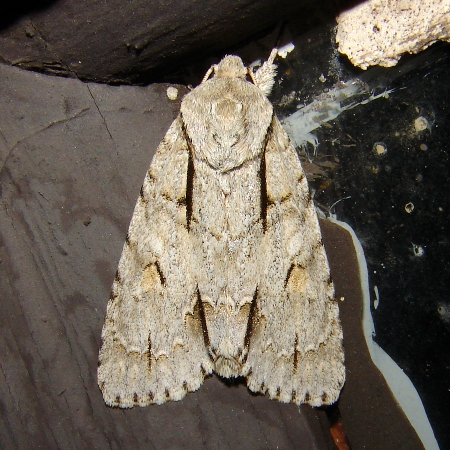
This lovely light gray moth is the American Dagger Moth (Acronicta americana). They are medium size moth with a wingspan up to 3 inches. The wings contain wavy lines in a variable pattern. They are associated with deciduous hardwood forests and nearby areas. The adults most likely do not feed and the caterpillars use alder, hickory, ash, willow, polar, elm, birch and other as their host. This particular species is the largest of the dagger moths in North America.
The caterpillars use birch, elm, willow, ash, walnut, hackberry, grape, alder, hazel, and oak for their host plant. These plants give the caterpillar a chemical protection from predation by forming distasteful toxins in its system. Most predators would avoid eating this species. Saturday, January 7, 2012
Winter Bees
I sat and watched the bees for about 30 minutes and found it very relaxing to observe them in their daily activity. Workers would fly out of the hive, and return several minutes later, laden with pollen. Some workers were met at the entrance of the hive by additional workers that would quickly feed them a bit of pollen, before they entered the hive.
Then I noticed several dead bees on the ground below the hive entrance. I assume these are the workers who perished over the last few weeks. They had been swept out the door of the hive; one thing any self-repecting honey cannot abide by is a messy hive. Dead bees would definitely qualify as dirtying up the hive.
Upon further observation I noticed a bee come in for a landing at the entrance, it was not carrying pollen as it slipped inside. It wasn't long before this intruder was rudely escorted out of the hive, onto the ground and stung repeatedly before succumbing to death. The message was loud and clear "Don't come around here, you're not welcome!"
(The worker on the left was one of my bees, the one on the right under the blade of grass is the "robber" bee)
Honey bees will often try to invade the hives of other bees to steal their stores of honey and pollen. The intruders are often quickly detected by scent alone. The robber bees will smell different than the members of the hive and are quickly deposed of. To me it seems a folly on the part of the robber bee, why sacrifice yourself to try and steal some honey? Do the robber bees think it would be easier to risk life and limb, than to gather their own pollen or nectar? Granted this time of year their choices are limited, but still, is it worth dying over?
Occasionally I had to laugh as the bees would fly in to make a landing and seemed to judge the distance all wrong. These bees would crash into the hive, or into the grass around the hive, or sometimes into each other. One little worker crashed into her fellow hive mate, and spun herself around and quickly caught her balance by grabbing her sister bee. It was quite comical, as she held on as if her life depended on it. I am sure she experienced a moment of WTH just happened!? After several seconds she regained her composure and flew into the hive. Silly bee.
I am so excited to see that the bees are doing so well. I realize we have had a mild winter up to this point and that it will most likely change soon. My hope is that they continue to do well and survive any harsh weather that the winter is still likely to throw at us.
Monday, January 2, 2012
Fresh Water Mussels
As you can see the kids were having fun diving for mussels in our pond. What a great way to spend a hot summer day!
There are hundreds of fresh water mussels in the World, and nearly 300 of them live in North America. In fact North America is home to the largest variety of mussels compared to anywhere else in the World. Many are in threat of becoming endangered, in fact the estimate is as high as 3/4 of the known species may be in peril. As many as 35 species have already gone extinct. The Midwestern portion of the United States contains the highest concentration of species, Missouri alone is home to some 65 species. Native Americans utilized mussels as an important part of their diet. Not only were they a valuable food source for tribes throughout the Midwest, but they also held value in other ways. The shells were used for tempering pottery and tools, they also made jewelry, and utensils. In the late 1800's "white man" recognized the potential value of the shells in the fashion industry. The button industry reached a boon during this time in history and many mussels were collected for the "mother-of-pearl" and sold to the button factories. The epicenter for the button industry was right in the good old Midwest.
As many as 200 button factories were in operation by 1912. Barge loads of mussels were harvested each season.This over harvesting of mussels drastically affected the population of mussels. It wasn't until the use of plastics came in vogue during the 1950's that the interest in mussels for buttons waned.
The livestock industry also benefited from the harvest of mussels, by manufacturing livestock feed from the soft parts of the mussels.
With the advent of plastics it seemed as if the mussels would be left to rebound depleted populations, but that was not to be the case. The Japanese discovered that mussels could be used to create cultured pearls. The mussels are boiled and cleaned. The shells are then formed into small beads and inserted into the shells of oysters as an irritant. The oyster will form a pearl around the irritant and the resulting pearl is sold as a "cultured pearl". Thousands of tons of mussels are collected, boiled, cleaned, formed into beads and shipped to Japan for this very lucrative trade. Fourteen states still allow the harvesting of fresh water mussels to be sold for this purpose. There is some indication that certain species of mussels are immune to many types of cancer. There is hope that the components that allow the mussels this immunity will be isolated and will lead to cancer curing medicines to be created.
An added problem mussels face is pollution. Many areas where fresh water mussels occur are heavily polluted. The mussels cannot survive in those conditions. Mussels are filter feeders and consume micro-organisms. In heavily polluted water they are also consuming the chemicals and debris that are present in the water. Because of this sensitivity to pollutants they are considered indicator species. This basically means that biologist can determine water quality by the presence, or lack thereof of the mussels in a given aquatic habitat. Depending upon the circumstances much can be determined about water quality based on these mussels. If a pond that traditionally held mussels, suddenly is mussel free that would "indicate" a severe problem with the water conditions. A sudden decrease of mussels can also indicate a problem in progress. Mussels that remain can be collected and their tissue can be tested for the type of pollutant, and the extent of the pollution that is causing the problem. Many times biologists are able to head off a disaster because of the data collected in the mussels. Mussels are an important part of the aquatic ecosystem, not only for their ability to indicate water quality issues, but because of their ability to filter the water. This filter feeding increases the water quality and creates an overall healthier water ecosystem.
They are also an important component in the food chain. Many animals will consume mussels including herons, and other shore birds, skunks, raccoons, foxes, minks and otters are all huge fans of mussels. Even muskrats that are traditionally plant feeders will utilize mussels as a food source when other food is not available.
The life cycle of mussels is very unique. Males release sperm directly into the water, and the females filter the water and sperm directly into their cavities. Once fertilized the female will carry the eggs and young larvae called glochidia within her gills. Some species will release their larvae the same year they are fertilized, other species carry the young overwinter and release them the following spring.
After being released the journey to adulthood gets interesting. In order for the mussels to complete their lifecycle they must attach themselves to the gills or fins of fish....yes that's right FISH! Who would have thought that mussels rely on fish to survive. The species of fish used is all dependent upon the type of mussel in question. Some mussels have very species specific requirements and will only use one type of fish. For instance Pocketbook mussels need to find small mouth bass. So how do they insure that the proper host is found?
They use a lure in the form of a soft tissue that they wiggle which resembles a small minnow, the small mouth bass is attracted to the "bait" and comes in to investigate. Instead of finding a meal, it finds itself a host to a mouthful of glochidia. Such deceit! Many mussels utilize any fish available, but have a wide variety of methods to attract them. Oyster Mussels open their shells and expose a blue mantle. The bright blue color attracts nearby fish. When the fish swims in closer to investigate the mussel will clamp its shell down onto the fishes head and holds tight. As the mussel holds on the glochidia swim into the fishes mouth. I am sure the fish is much relieved when the mussel finally releases it. The young larvae remain attached to the host fish for up to 7 months depending upon species. Once they have reached maturity they will drop off the fish and lead a sedentary life. Mussels are very limited in their ability to move which is why they rely on fish to spread their populations. Of the millions of eggs produced by females and fertilized by males, only about 1 in a million will survive to the juvenile stage. Mussels are long lived creatures and many species may live a century or more. Other species live for decades and like many long lived animals they do not reach sexual maturity until they are older. Some species may be ready to reproduce at 2 years of age, and others it may not be until a decade later.
Other factors can affect the over all survival of mussels, including habitat destruction. This can be caused from dredging, damming and forming channels. Mussels are vulnerable in other ways too, consider that they have a later maturation rate, very low juvenile survival ratio, susceptibility to pollution, inability to disperse in a sustainable fashion, and host specificity. All these things combined makes a person wonder how they survive at all. On top of all these issues, they also suffer from competition with invasive species. Zebra Mussels have wrecked havoc on many fresh water environments. Zebra mussels originated in Poland and the former Soviet Union. They made their way to North America in the ballast water of ships. They were first discovered in 1988 in Canada, and four years later were found in the United States throughout the Great Lakes. By 1991 they were discovered in the Mississippi River. Humans are responsible in most cases for the expansion of the zebra mussels range. The mussels attach themselves to boats and other water craft and then are carried to new locations. Zebra mussels unlike many mussels have a very sort reproductive cycle which allows them to colonize areas in greater numbers. The presence of zebra mussels causes many problems for native mussels, because of their habit of attaching themselves to natives species. This interferes with feeding, movement, growth and reproduction of native mussels. In Lake Erie alone it is estimated that Zebra mussels are responsible for the 90% reduction of native mussels. It is vitally important that individuals frequently utilizing the water in a recreational manner make sure that their water craft is free of any attached mussels before heading to other waterways. This can go a long way in reducing the spread of these invasive species.
Sometimes the most unassuming creatures perform some of the biggest jobs. While mussels move very little, and are rarely seen they perform a huge job in purifying water, determining water quality, providing product to the jewelry and fashion industry, and providing food for many other animals. We as humans should try to reduce invasive species, limit habitat destruction or alteration, and reduce harvesting especially in locations where native species area already struggling to maintain viable populations. We also need to continue to reduce chemical runoff which greatly impacts these fresh water mussels.
I feel very fortunate to have such a healthy and large population of these mussels present in our ponds. This indicates to me that the water quality is superior and all the right components are in place to allow them to survive and reproduce. Now if I could just figure out how to make them palatable I'd have it made.
Resources: Texas Parks and Rec; MDC; and NRCS
Friday, December 16, 2011
Eastern Blood-Sucking Conenose
Saturday, December 10, 2011
Rarest Bumblebee in US Rediscovered
An elusive bumblebee, which was last seen in 1956, was recently found living in the White Mountains of south-central New Mexico, scientists announced Monday (Dec. 5).
Known as "Cockerell's bumblebee," the bee was first described in 1913 using six specimens collected along the Rio Ruidoso, a river located in the Sierra Blanca and Sacramento Mountains, N.M. Over the years, one more sample was found in Ruidoso, and 16 specimens were collected near the town of Cloudcroft, N.M.
The last Cockerell's bumblebee sample was collected in 1956. No other specimens had been recorded until Aug. 31, when a team of scientists from the University of California, Riverside, found three more samples of the bee species in weeds along a highway north of Cloudcroft.
"When an insect species is very rare, or highly localized, it can fairly easily escape detection for very long periods of time," Douglas Yanega, a senior museum scientist at the University of California, Riverside (UCR), said in a statement.
Cockerell's bumblebee has the most limited range of any bumblebee species in the world, having been spotted only in an area of less than 300 square miles (777 square kilometers), according to the researchers. By comparison, the rare "Franklin's bumblebee" species, which was last seen in 2003 and is on the verge of extinction, is known from a distribution covering about 13,000 square miles (33,670 square km).
Cockerell's bumblebee was able to fly under the radar for so long because the area where the species lives is rarely visited by entomologists, Yanega said. The bee species has also "long been ignored because it was thought that it was not actually a genuine species, but only a regional color variant of another well-known species," Yanega explained.
An assessment of the genetic makeup of the three newly discovered specimens gives fairly conclusive evidence that Cockerell's bumblebee is a genuine species, the researchers said.
It is not unusual for an insect species to be rediscovered after several decades, when people might otherwise have believed it had gone extinct, Yanega said. UCR entomologists rediscover many "lost" insect species like the Cockerell's bumblebee, as well as discover entirely new species, at the rate of several dozen species every year.
"There are many precedents – some of them very recently in the news, in fact – of insects that have been unseen for anywhere from 70 to more-than-100 years, suddenly turning up again when someone either got lucky enough, or persistent enough, to cross paths with them again," Yanega said. "It is much harder to give conclusive evidence that an insect species has gone extinct than for something like a bird or mammal or plant."
Cockerell's bumblebee does not appear to be facing extinction. The bumblebee dwells in an area that's largely composed of National Forest and Apache tribal land, it is "unlikely to be under serious threat of habitat loss at the moment," Yanega said.
However, the researcher notes that since the bee species' biology is completely unknown, it may require additional formal assessments in the future.
You can follow LiveScience writer Remy Melina on Twitter @remymelina. Follow LiveScience for the latest in science news and discoveries on Twitter @livescience and on Facebook.