Sunday, April 10, 2011

Viewer Descretion Advised

This pretty little bird is probably one of the most recognized birds in Missouri, perhaps even the whole of the United States, this is the American Robin. Many falsely believe that these birds are the harbinger of spring, but in reality they are here year around. The numbers are usually lower in the winter, but they are here nonetheless. Robins are common around homes, hopping around yards looking for worms. Unfortunately, like many birds that hang around human dwellings, collisions with windows are common. Today while I was weeding the flowers I discovered a robin lying dead among the flowers. This always disheartens me, as I hate for any bird to die, especially a death that should be preventable. I actually do have something hanging in my window that should help avoid these collisions, but alas it did not work for this unfortunate victim.

I picked the bird up to properly dispose of it before our dog sniffed it out. When I lifted the body, I discovered that mother nature was already hard at work breaking down the body of this bird body.

If you are easily grossed out or have a weak stomach, this is where you will want to shut your computer off.....or at least exit MObugs......

I warned you.....


Flies had laid eggs on the freshly deceased body, by the size of the maggots I would guess this happened about 3 days ago. There were dozens of these maggots busily feeding on the flesh, it gave the illusion that the bird was still alive as it writhed with the motion of the feeding maggots.


While the smell was a bit overpowering, I couldn't help but watch as these creatures fed. Their bodies moving in a very purposeful way. They even possessed enough sense to retreat from the light, and from my disturbance. Their bodies moved in a very Blob-like way, reminiscent of the way a seal would move. You could see blood circulating throughout the body, within almost transparent skin.


Each segment of the body is visible in this picture, as is the blood-pocket. Fully grown maggots can reach over a half inch in length. Mature blow fly maggots are creamy in color. Maggots have a very typical body shape; the head end is slender and tapers to a point while the rear end is thicker and ends bluntly. The hook-like mouth parts are the only visible part of the head of these flies. The rear end of the maggot has two kidney bean shaped patterns on the end; these are spiracles used for breathing. Spiracles are used to identify the family and species of fly maggots since, superficially, they all look the same. Mature maggots will pupate. The pupa is concealed in a red-brick case called a puparium. These are smaller than the maggot and more circular in shape. Adult blowflies resemble house flies in shape but are often metallic green or blue in color.

Adult blow flies lay eggs on or near rotting vegetation, manure or animals. Eggs hatch very quickly, and maggots begin to consume the decaying food. Maggots pupate and emerge as adults within a few days, depending on the temperature. Total developmental time from egg to adult can happen as quickly as a week, given good conditions, and depending on the species. They develop and consume food quickly, so much so that when a maggot has matured, it moves away from the food source to digest and prepare for pupation. During this movement away from the food, a maggot can travel quite far, up to 100 yards.

Certain live maggots have been employed since ancient times as an economical, safe and effective type of wound debridement. In controlled and sterile settings by licensed medical practioners, maggot therapy introduces live, disinfected maggots into non-healing skin or soft wounds of a human or other animal. They eat the dead old tissue, leaving the live tissue alone. It is uncertain if maggot secretions have any effect on bacterial growth, since different studies have produced contradictory results, and some species of bacteria may be naturally resistant to maggot secretions. As of 2008, maggot therapy was being used in around 1,000 medical centers in Europe and over 800 medical centers in the United States. While it can be a bit discerning to think about maggots writhing in an open wound on our body, it sure beats necrosis and death by infection. We as humans have a natural aversion to all things creepy and gross, and maggots sure qualify as creepy and gross. If you can manage to get past the obvious, and look at the not so obvious one can begin to see they are remarkable creatures. While none of us loves flies that have the potential to spread disease and contaminate foods, we should however marvel over the work their industrious offspring carry out. They are the clean-up crew....consuming untold amounts of rotting, decaying flesh. Imagine a world without maggots, vultures, carrion beetles and other unsavory creatures to clean up the deceased bodies of all manner of creatures. It would be a vile, stinky place. I have a tendency to favor the underdogs of the natural world, and for me these beasties are definitely underdogs.


A house fly is attracted by the scent of death, she lands on the wings of the deceased Robin. Perhaps this rotting bird will provide for her offspring as well. So while it is sad that the Robin lost its life, through death it is able to give life to some of natures most loathsome and misunderstood creatures. Mother Nature thinks of everything!

Wednesday, April 6, 2011

Falcate Orangetip

(Photo by: Steve Scott)

This delicate-looking little butterfly is the Falcate Orangetip (Anthocharis midea) and they are found throughout the Eastern United States in open wet woodlands, near waterways, open swampy areas, and sometimes near dry wooded areas and ridge tops. They are in the family Pieridae with sulphurs and whites.This butterfly is often considered the harbinger of spring because they are one of the first butterflies to be seen early in the spring. They typically fly low to the ground in their woodland habitats.
This butterfly was first described in 1809 by Jacob Hubner. They are found only in North America and are most common in Texas and Oklahoma. This butterfly was first described in 1809 by Jacob Hubner. They are found only in North America and are most common in Texas and Oklahoma.


Orangetips are easy to identify with their distinctive orange tips (males) on their all white wings; females lack the orange tips (typically). They are small with a wingspan up to 1 3/4 inches. The underside of their wings is heavily marbled with a greenish tint.

Males will patrol for receptive females, and once mated the female will lay her eggs singly on the leaves of plants  in the mustard family. These include winter cress, and rock cress. Females, like many butterfly species have the ability to detect if other eggs are present on a particular plant, and she will lay her eggs elsewhere. The caterpillars feed mostly at night on the seed pods, flower buds and flowers of the host plants.

(Photo by: Dave Wagner--taken from Discover Life website)

The adults of this species nectar at a wide variety of flowers and tend to be very easy to approach and will tolerate humans more so than most butterflies. A good friend of mine wrote this verse about Falcate Orangetips and I thought I would share it with you.

Falcate Orangetip

The caterpillars stay out of sight
Feeding at night aids obscurity
Adults look for mates while the time is right.
Neither gets social security.

                                             By: Richard Lewin


Each year I am on the lookout for this species and I have yet to find it.        

                                       Maybe this will be my year!


Monday, April 4, 2011

Golden Dung Fly

This pretty yellow fly is called the Golden Dung Fly (Scathophaga stercoraria), they are also called the Yellow Dung Fly. While it is true that they are pretty, they hang out in very unsavory places, namely piles of cow dung. They measure up to 3/8 of an inch in length, males are bright golden-yellow with orange-yellow fur on the front legs. Females are a little duller in color with green-brown tinges. They also lack the bright fur on the front legs.

These flies are predators and feed on a wide variety of insects. Those that are found on flowers are not after nectar, they are after the insects that are after the nectar. Those that are found on piles of dung, are feeding on the blow flies and other insects that are gathered on the dung. Females gather at the dung piles to feed and to deposit eggs on the surface of the poo. They will lay their eggs in the small hills of the dung, avoiding points and depressions as these areas dry out more quickly. Moisture is needed to insure the survival of the eggs and the larvae.  Depressions may also store excess water after rainfall and would drown the flies offspring, so it is key to their survival that the female lay her eggs exactly where they need to be. When the eggs hatch the maggots are also predatory and will feed on small insects found in the dung. In about 20 days, give or take a few days depending on the weather conditions, they will fall to the ground and pupate. In several days to a couple weeks the adults will emerge. They are capable of having up to five generations per year depending on their location and the weather.

Many things feed on these flies, including birds, insects and bats. Robber flies are particularly fond of these flies.
These flies are even susceptible to sexually transmitted diseases that are commonly spread by mites or fungi. This causes sterility in the fly or can outwardly kill the fly. In either case it has a detrimental affect on the ability of this fly to reproduce.


This is the first I've ever spotted this fly, now I am prompted to seek out the cow patties on our farm to further investigate what species beside the typical blow flies are using the cow piles as either a food source or an incubator for their eggs.

Sunday, April 3, 2011

Citronella Ants

Citronella ants in the genus Lasius (claviger group) claviger. They get their name from the lemony citronella-like scent they emit when they are disturbed. This fragrance is much more noticeable when they are crushed. Even though they are found throughout the United States, they are more common in the Eastern United States. These ants live in underground chambers, or within tree stumps and logs.


Often confused with termites when they make it into homes, which could be because of the winged individuals that show up at certain times of the year. They are larger than the typical workers of the colony and vary in color from light yellow, light brown or dark reddish-brown. The workers are almost always yellow, or this light yellowish-orange. Workers of this species measure about 1/4-inch in length. Two closely related species are smaller. The winged females and males that swarm to start new colonies may measure up to 5/8-inch and 3/8-inch, respectively.


Not much is known about their underground colonies. They are believed to milk subterranean aphids for honeydew, just like dairy farmers would tend their cattle. Nest sites may include open woods, pastures and fallow fields, gardens, lawns, and next to house foundations. Also, some colonies are located beneath concrete slabs and large rocks, and in and beneath rotting logs.

Citronella ants should be considered only as a nuisance pest species. Normally, they go unnoticed unless the swarmers enter through expansion cracks in slabs or around door openings. Although these intrusions may alarm homeowners, the ants will not reproduce within the home nor will they attack stored goods or structures.

In some cases, swarms may occur repeatedly and attempts should be made to locate the colony or colonies. Colonies typically have mounds of soil around the openings where excavated soil is deposited. These mounds can be treated by injecting an insecticide into the holes. Although numerous insecticides are labeled for ant control, many of these can only be used by licensed individuals. Therefore, a professional pest control company should be contacted because they can use materials not available to the general public and have access to specialized application equipment.

Pesticides are poisonous. Read and follow directions and safety precautions on labels. Handle carefully and store in original labeled containers out of the reach of children, pets, and livestock. Dispose of empty containers right away, in a safe manner and place. Do not contaminate forage, streams, or ponds.


I took the liberty of copying most of the information about this species directly from the website listed below. They did such a wonderful job of describing this species, that I could not see how I could improve upon it. You will find that many of the websites out there that talk about this species are in terms of eradicating it from homes. I liked this particular website because it does not promote pesticide companies, it merely gives valuable information. It does however give advise in the event that you should find yourself in need of removing these species from your residence.

Resources:
http://ento.psu.edu/extension/factsheets/citronella-ants

Friday, April 1, 2011

Vinegaroon


This large prehistoric-looking creature is a Vinegaroon or Whip Scorpion, they are related to spiders and scorpions in the class of Arachnida. They are in the order Uropygi which means "tail rump" which refers to the whip-like appendage at the end of the abdomen. This particular specimen pictured here is Mastigoproctus giganteus which is native to the southern and south western region of the United States. They are one of the largest vinegaroons of the 100 species found Worldwide, and they reach lengths up to 3.5 inches without the tail appendage added in. Like spiders they have 8 legs, with the two front legs being specially adapted as sensory organs which allow them to feel around their environment much like a blind man uses a cane to acquaint himself with his surroundings. They have modified mouthparts that resemble boxing gloves, but are actually pinchers capable of pinching human skin as well as grabbing their prey. 


Unlike spiders they have no venom glands and also unlike scorpions they lack a stinger. Their only form of defense is a special chemical they can spray from their tail that is made up of acetic acid and octanoic acid and smells like vinegar. It is this vinegar-like spray that they get their common name of VINEGARoon from. This spray is harmless to humans unless you are sensitive to vinegar. It may be best to not handle them  as the only way to know if you are allergic is to get sprayed. Avoid holding them near your face, as getting this spray in your eyes would be a bad experience. I handle this one frequently and have had no problems. As long as you approach them quietly and in a non-threatening way, handling them should not be a problem, but be aware that a reaction could occur and medical assistance may be needed for sensitive individuals.


They are found in tropical, sub-tropical and hot dry areas. They are absent from Australia, Europe. There are introduced species found in Africa, but no native species are there. They will dig burrows that they transport their prey to. They avoid sunlight and prefer dark, humid locations. They may also be found under rock piles, wood piles, rotting wood, and other natural debris. They even show up in basements, garages and sheds in their native range.Vinegaroons feed on insects, millipedes, worms, slugs and small vertebrates. While it is true they are a bit scary and intimidating looking, there is nothing to be afraid of, they in fact provide a valuable service to us in the form of insect control.

Males will form a sperm sac called a spermatophore that they will deposit on the ground. Much like a scorpion they will drag the female across this sperm-sac so that she will take it up into her body. She will lay up to 35 eggs in a burrow. The eggs are encased in a protective mucous membrane to keep them moist. When the eggs hatch the young will crawl up on their mothers back and attach themselves there with a suction-cup like devise. They will remain with the mother until they shed their skin for the first time. They will be all white and very vulnerable at this stage. Staying with their mother affords them some protection. The mother will not eat throughout the egg laying process....and she will die as soon as her offspring molt. The young are slow growing and will not reach adult size for 3 years. They may live up to an additional four years after reaching their adult size. 

Tuesday, March 29, 2011

Spine-waisted Ant

This pretty little ant is a Spine-waisted ant (Aphaenogaster tennesseensis) in the family Formicidae. Some refer to this ant as an Orange-Spotted Ant, which I rather like, but I think Copper-Bottom is a much better common name, after all just look at that abdomen.

They are associated with woodlands and can be found inside decaying wood, or rotting logs. The ants pictured here were found inside a rotting log in our timber. These ants will herd aphids leafhoppers and milk them for honeydew. Honeydew is a favorite sweet treat among a lot of ants and many different species will be found guarding them. This is a beneficial relationship to both species. The ants get their favored honeydew and the aphids gain protection from would-be predators. 


In this photo the worker is carrying a larvae to safety after the colony was disturbed (by me...oopsie). The number one priority of the workers is to expand the nest sight, and to care for the offspring of the queen. These ants are like many other ants in that they forage for food, and will carry bits and pieces of insects, seeds and other foods back to the colony to feed on. These ants are quite strong (as all ants are) and are capable of carrying much larger prey species than they themselves are.


These ants are also reported to be parasitic on other ants in their genus...such as A. rudis or A. rudis picea.

 The following additional information on this species was provided by Missouri's Ant Expert James Trager...."James, thank you for sharing your vast knowledge." 
 

This is a common eastern US species of forests and woodlands, and also occurs in yards, parks and urban areas with large trees. It nests in dead trees, in rotting heartwood of living trees, and also in fallen logs. It is rare in prairie, but sometimes is found in decomposed wood in prairie groves or in isolated old trees. A. tennesseensis is a known temporary social parasite of perhaps all of the A. rudis-texana group species. The queen is small, shiny, stout-spined, and thick-cuticled, with long, stout propodeal spines, presumably all helping her gain entry to a host colony. See the pictures on this page and note the similar size but difference in build of the queen and workers: http://www.antweb.org/description.do?rank=species&name=tennesseensis&genus=aphaenogaster&project=illinoisants.
The food of this ant is mainly small invertebrates that inhabit dead wood in which it lives, and they are not as eager in the pursuit of sweets as many other ants. They mainly gather honeydew off the ground and leaf litter, rather than directly from the bugs, or drink from fallen fruit. 


 This particular species might be one of the prettiest ants I've ever seen in terms of color. With winter struggling to lift its chilly bonds, there is very little to see in terms of insect life. Everything is still tucked away safe and warm and out of sight. I am resorted to tearing open logs and peeking under rocks for anything living and moving. Oh the desperation of a winter-bound entomologist!

Saturday, March 26, 2011

Water Scavenger Beetle

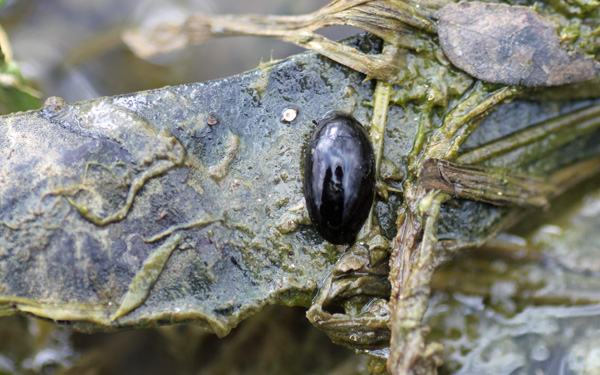
I read this quote online about these beetles and had to chuckle at its truthfulness:  "This is a water beetle. It is the hardest object in the world to pick up with tweezers. The second hardest is Mount Everest." I wish I could find out who first said it, but there was no name associated with the quote.
Water scavenger beetles are in the family Hydrophilidae. These beetles are predominately aquatic and will be found near ponds, streams, lakes and other small bodies of water. We have a small wetland on our property and there are hundreds of these beetles present there as well other aquatic insects. This little wetland is one of my favorite areas to visit on our farm, there is always something interesting to see. As larvae they live under the surface of the water and prey on other insects. As adults they vary their diet between vegetation and other insects as well scavenging on decaying animal and plant matter.These beetles are very difficult to identify to species, and with over 225 species in 34 genera it is easy to see why. Many of them look very similar and closer inspection of their underside, antennae and leg hairs is required for a more accurate identification. 


These beetles have very shiny elytra; you can even see your reflection in their wings.....(first photo shows my own reflection as I photographed this particular beetle). They range in size from 1/4 of an inch up to 1 1/2 inches or more. Not all beetles in this family are aquatic, some are terrestrial and will live under rich damp soil, or in dung or decaying leaf litter. The beetles associated with land typically are herbivores and feed on vegetation exclusively.  

We typically find insects at our porch lights, or at the family picnic, or while walking through our gardens, but many of us don't associate insects with water. Many insects in fact begin their lives in water and live near water their whole lives. Exploring ponds, streams and lakes or any other temporary body of water often yields some interesting finds. 

Friday, March 25, 2011

Many of you may not know that I also have another blog called Explore Missouri. I have seriously neglected it over the past year and hope to get back on track in posting interesting information about Missouri's natural resources. If you have time and are so inclined take a few minutes to visit EXPLORE MISSOURI. The newest update is all about our very own White-tail deer

Thursday, March 24, 2011

Sawfly

This pretty little black and orange insect is a Sawfly (Dolerus unicolor). Sawflies are not flies at all, but are related to wasps and bees. Even though they are closely related to stinging insects, they cannot sting and are harmless to humans. They get their name "sawfly" from the saw-like ovipositor that the female has, which she uses to deposit eggs inside the stems of plants. This particular species gets its name from the all black male. In the spring these insects are often the first to appear on warm days. I found this one floating on a dead leaf inside one of our cattle tanks. I rescued it and let it dry out. After shaking its wings a few times, it flew off for safer areas.
(Sawfly, shaking her wings to dry them out)

The larvae of sawflies look very much like caterpillars, in fact I have often mistaken them for caterpillars, only to learn via bugguide.net or other resource that I was wrong. The following are some examples of sawfly larvae. Each species of sawfly is usually host specific and will be found on its own particular food choice.

(Found on Elderberry Bush)

(Found on Poison Ivy)

(Found on grasses)

(Found on Elm Tree)

As you can see the diversity of these larva is incredible, and I just love finding them and photographing them. You can also see how very much they look like caterpillars. One key difference Caterpillars can have up to five pairs of abdominal prolegs, but never have more than five pairs. Sawfly larvae always have six or more pairs of abdominal prolegs.


Sawfly Larvae


 Here is a couple of diagrams to help you ID your caterpillar or sawfly larvae.

I can hardly wait until the weather finally warms up and stays warm so I can get outside and look for these wonderfully unique insects.

Sunday, March 20, 2011

Black Carpenter Ant


This very large ant is a queen carpenter ant (Camponotus pennsylvanicus) in the family formicidae. They are one of the most commonly seen ants in my area and possibly easiest to identify. They are listed as a pest species because of their habit of turning up where they are not wanted, such as our homes. Moisture is a huge attractant, they tunnel into moisture damaged wood and can cause structural damage to homes, and other buildings. To keep them away from these structures, make sure water drains  away from your home and buildings. Do not leave boards lying on the ground, as this draws moisture and may attract the ants. In the wild they are beneficial in breaking down rotting wood into organic matter that adds nutrients back into the soil. You will find them in decaying logs, and trees (where this queen was photographed). The workers come in many sizes, some can be quite large. While they do not sting, they can give a pretty good bite, then to make matters worse they may spray formic acid in the wound for good measure. These ants are fiercely territorial  and will defend their colony from other ants or other invaders. 

While they live in wood, they cannot digest the cellulose that is in wood. They chew into wood only to make their tunnels and excavate their home. These ants are omnivores and will eat most anything including animal matter, fruit and plant juices, dead insects, syrup, honey, sugar, fruit, grease, meat, and a wide variety of other substances. A favorite is the honeydew secreted by aphids and other tiny insects. They will forage up to 100 yards away from the colony.

In late spring winged individuals may make an appearance. These are young males and females called alates. They are leaving the colony to seek mates and to start a colony of their own. As soon as the females are mated the males all die and the females will chose a nesting site to begin her colony then her wings will drop off. She has been mated for life and her sole purpose is to lay eggs for the rest of her life. She will begin by laying 15 or so eggs, they will hatch in about 24 days, she will feed them a liquid diet that consists of  her own stored fat reserves and wing muscles. 


Once these larvae have matured they will take over the care of future offspring of the queen, as well as cleaning the nesting site and searching for food. They will also guard the colony, queen and their siblings. Later in the season "major" and "minor" workers are created, these will be highly variable in size and have different responsibilities in regard to the colony. Some are the foragers that gather food, and others remain in the colony to expand it and care for the offspring. If the colony is disturbed the ants will carry the larvae and pupae to safety. They must be tended to or they will perish. In about 5 years the colony may contain up to 3,000 individuals. In the fall alates will be created, but they will not swarm until the following spring, then the cycle will start all over again. In some cases workers may leave the colony taking larvae and pupae with them and create a "satellite" colony away from the original colony. This is one other way they divide and expand besides swarming. 


With the return of spring upon us it is very common to find these ants in our homes, especially in bathrooms and kitchens where they are looking for water as well as food. Typically they will be found at night as they are nocturnal by nature. How do we control them? Prevention goes a long way, as mentioned above, remove lumber, firewood or anything else that is stacked near your home to discourage them from showing up to begin with. Make sure you repair any damaged wood on your home, do not let wood window frames, siding, railings, porches and other features of your house decay to the point that it will attract these ants. Repair cracks in foundations to keep them from entering your house that way. Make sure you do not have leaky outdoor faucets or any other outdoor water source. If you already have an infestation, you can try bait traps. Insecticide sprays rarely work well anyway, as the ants may just move elsewhere inside your home, until the residue is gone from the spray then they return. Additionally sprays can be harmful to us to inhale as well as to pets, especially pet birds. Baits on the other hand seem to be more effective and much safer to use. Regardless of the method you may decide to use to control them, please read all labels and follow the directions carefully.