Saturday, February 26, 2011

Simandoa Cockroach

It is funny how things go sometimes isn't it? I say this because recently I made a new friend on facebook. This man goes by the name of Piotr Naskrecki. He is an accomplished entomologist, author and photographer. In fact I have one of his books "The Smaller Majority" that is full of his wonderful photography. It is one of my favorite books and truly one of the inspirations of my own photography. I hope to one day take photos as great as his images. 

Through this new friendship; I discovered  he had mentioned on his facebook page that he had a species of cockroach that he would be willing to share with his friends and followers in order to keep the species alive for future generations. I simply cannot resist the opportunity to own unique and wonderful insects and cockroaches have long been a favorite of mine. I currently own 4 species and one subspecies of cockroaches and the chance to own another was more than I could stand. I quickly responded to his comment and expressed not only interest in owning these beautiful roaches, but my excitement at the prospect. He graciously wrote me back and assured me that roaches would be on their way to me within the week. True to his word they arrived the following week. 

I did a little research on this particular species and very little is to be found on the internet beyond what Dr. Naskrecki  has written himself. I researched the area where they are from and found some interesting data, but still very little in reference to insect life. They are from Guinea, West Africa and reside in caves located in the mountainous area of Pic de Fon. Many of the caves are being mined for iron ore, much more mining is scheduled to begin before the year 2015 which puts these and many other creatures at risk to loss of habitat and perhaps displacement or even extinction.

This Guinea area was biologically one of the richest and perhaps the most endangered terrestrial regions on the planet. Over 70% of the original forest is gone due to human encroachment mostly due to agriculture and mining. The few areas that are left are a biodiversity dream. There are many habitat types including Savannas, lowland forest, rainforest, montane and gallery forest as well as endangered West African Montane grassland. The area of Pic de Fon is in comparison to other areas in this region relatively untouched, but with the scheduled mining that is due to take place that will soon change exponentially. Change is inevitable, but often unfortunate. Many habitats suffer greatly as well as the creatures that call them home. For many years this area was considered safe from human development because of its isolated location, but this has changed over recent years and is now faced with threats that range from agriculture, poaching, logging, uncontrolled bush fires, road development to human population growth. With very little law enforcement in the area the threats increase, and control over these activities is hard to manage. Now with the added threat of mining the area seems destined to follow the way of so many other areas like this; eden to wasteland.

Simandoa Cockroaches live in the cave(s) scheduled to be mined, and very little is know about them other than they are a recent discovery and now threatened by extinction. Do they occur in other caves in the area? Do they occur in other habitats or are they restricted to caves? If the destruction of their habitat continues, how will these and many other questions be answered? How sad to be discovered, and subsequently faced with extinction in a very short time span. For now it appears that this species is strictly from a particular cave in this region and with the current mining operations will likely be imperiled if not completely destroyed. They inhabit the mouth of the cave where light is still present, therefore they do not exhibit any of the typical characteristics of most cave inhabitants. They do not lack pigment, and they have full sized eyes and normal wings. They are being classified in the family Blaberidae with many other species of roaches. They live in bat guano, but I could not find information stating if it is the bat guano they feed on, consequently breaking down the waste of bats into nutrient rich substrate on the floor of the cave, or if they feed on other substances that are perhaps attracted to the guano or growing on the guano. With the lack of guano at my disposal they are eating carrots and seem to like them just fine. Dr. Naskrecki is feeding their colony carrots as well and recommended I do so as well. I commend the efforts of people like Dr. Naskrecki who have the foresight to capture these insects to prevent the dying out of a species. All too often plants, animals and invertebrates are destroyed before we fully understand their place in the environment, what if these roaches carry the cure for some rare disease, or answers to biological problems within their genes? Now we have a chance to learn from them and enjoy them as a species. 

My small colony of Simandoa's arrived in the mail Wednesday. I was in Kansas City attending a week long workshop where my husband called me and told me I had a package. I knew what it was and asked him to bring the box when  he came down to dinner. I simply could not wait until Friday to open the box and see them. Thursday morning I took them to the workshop with me as I did not want to leave them in the hotel room for fear the maid would accidentally knock them over or open them. At the workshop one of the gentlemen in attendance wanted to photograph one, I took one out and posed it on my hand and he snapped the photo, what he didn't know was that I thought one of the nymphs had fallen on the floor when I took the adult out for the photo. I told the woman next to me and her and I looked but did not see one so I thought perhaps I imagined it. An hour later we had a guest speaker, and approximately 30 minutes into his talk I felt something tickle my knee (underneath my pants) and I was pretty sure it wasn't the guy sitting next to me. I felt my knee but could not feel anything beneath the fabric. I thought again I must be imagining things, and perhaps I had bugs on the brain. Perhaps another 30 minutes went by, and our lecturer was still talking and interacting with our group when I felt something tickle my thigh. I looked and I could see the perfect outline of a roach through my pants. I nearly laughed out loud. I poked the woman next to me and pointed to my leg....she saw the outline and whispered "is that what I think it is?" I shook my head yes, she almost started laughing too. I told her I needed to go to the bathroom and take care of this little problem. So I quietly exited the room and once I got to the bathroom, dropped my pants and fished out the roach; it once again hit the floor. I spent 5 minutes chasing the fast little bugger all over the bathroom before finally catching it. When I left the bathroom my friend and cohort had brought the container to me so I could safely ensconce him once again. Her and I laughed and mentioned it was a darn good thing it didn't crawl up anyone elses pants. I couldn't help but get a mental image of someone in the room with this errant cockroach climbing their pant leg and the mass panic that would have ensued. I nearly busted a gut at the image it presented. Fortunately nothing so dramatic happened and they are now safe at home in a ten gallon aquarium with a tight fitting lid so we do not have anymore accidental escapes. Life is never dull around here, and thankfully so.

Resources:
http://www.jstor.org/pss/3503709
http://en.wikipedia.org/wiki/Simandou

Wednesday, February 23, 2011

Running Crab Spider

This photograph was taken last summer, and subsequently forgotten about. I came across it a few weeks ago and realized I had no idea what this spider was, nor could I even remember the circumstances behind taking the photo. I submitted it to Spideridentification.org and within 24 hours I had an ID on this modestly colored arachnid. It is a Running Crab Spider in the genus Philodromus and I have Eric Eaton to thank for the prompt identification. I often come across new or unusual insects and spiders that I simply cannot find in my field guides or I am at a loss where to begin looking. When these situations arise without people like Eric out there in cyberspace providing us this valuable information it would be very difficult indeed to name these creatures, much less learn anything about them.

Running crab spiders are native to the United States as well as most the World, and with 500 species it would seem they would not be hard to find. The fact is though, most of them are drably colored in shades of tan or brown and they very easily blend in with their habitats, so actually seeing these spiders might be more difficult than one would expect. They are a relatively large spider with a legspan around 1 1/2 inches, and like all crab spiders their two front pairs of legs are much longer than the other legs giving them a superficial "Crab-like" appearance. They are distant cousins to the traditional crab spiders (Thomisids) we find in our gardens among the flower blossoms. However these spiders differ in a few ways, for one they are much larger, and they lack the hairs that cover the bodies of crab spiders in the Thomisidae family.

These spiders do not build webs, instead they catch their food by sitting and waiting patiently for insects to pass by. They will reach out very quickly and grab their prey with their long front legs and deliver a deadly bite that injects their victim with venom. Some reports state that this venom is one of the most toxic in the spider world, which allows for them to subdue their prey quickly. Without a web to tangle up their food, like orb weavers use, it would be easy for prey to escape. Without having some means of quickly immobilizing their prey they would go hungry. This venom is not dangerous to humans, it is only dangerous if you happen to be fly-sized.

These spiders do however have silk, just like all spiders, although it is used in a different way. Instead of using silk to build webs, they use it to form drag lines to move from one location to another. Silk is also used by the females to create egg sacs that protect their offspring.These crab spiders can be found in a wide range of habitats, depending upon species. Some are associated with human dwellings and rest on the outside of buildings where they often blend in with siding or brick. Some are found in prairies and grassy areas, and still others prefer forested areas. Keep in mind when out exploring, some of the most fascinating creatures may be some of the hardest to see. Slow down, look around and discover what might be right in front of you.

Tuesday, February 22, 2011

crawdad communication

I had to update you all on the crawdad situation. When I first put her in the tank, each of the 200+ baby crawdads let go of their mother and began swimming around. Nothing so strange about that, in fact it seems pretty normal right? Well, here comes the strange part.....last night when I checked on her all of the babies were once again in a ball under her tail being carried by her. How did they know to come back to their mother? Is there some form of communication taking place, wherein the mother "tells" her little ones to huddle up? Does this type of behavior take place outside in their natural setting, or is this behavior a protective instinct brought on by captivity? Any opinions?

Saturday, February 19, 2011

Ice Skating Crawdad


My friend Cindy and I decided to take a drive and look for things to take pictures of. While slowly driving along a narrow roadway, she looked at me and said "Don't think I'm crazy, but I'm pretty sure there is a crawdad crawling on the ice back there" I backed up the car and we got out to investigate. Sure enough there was a very large crawdad, moving very slowly along the top of the ice in a narrow frozen channel of water. We grabbed a long stick and climbed down the bank and used the stick to move the crawdad towards us. It was at this time we noticed something under her tail. At first we thought it was parasites, then we realized it was her babies. Why was this crawdad on top of the ice? Did our unseasonably warm temperatures of the past few days confuse her and wake her up? We knew she would not survive the impending cold temperatures predicted for the night. I made the decision to bring her home and try to keep her alive until spring when I can release her.


I had no idea that crawdads carried their babies in this manner, and was thrilled to learn something new. The picture, above, shows part of the "baby ball" still attached to her tail. As soon as I placed the crawdad in the water of a 5 gallon tank, the babies immediately let go and began swimming around. The female seemed relieved to be warmer and off the icy mess she had gotten herself into.


There are approximately 200 baby crawdads swimming around with their mother. My husband said he had one as a pet when he was a young boy. He named it "big daddy" and he fed it oatmeal. It lived for 2 years. I placed a few flakes of dry oatmeal in there with her, but so far she doesn't seem interested. Perhaps her metabolism is still telling her it is winter and she just doesn't have the urge to eat yet.


The babies are very tiny. This one is pictured on the top of my thumb and measures less than 3/8 of an inch. Truly mini replicas of their mother, right down to the fan tail and the buggy eyes. I am so glad Cindy noticed this crawdad on top the ice. This was a wonderful opportunity for us to witness a great moment in the life of this crawdad. I am equally glad that were able to get her off the ice and somewhere warmer before the night time temperatures caught her off guard and she succumbed to below freezing weather.

Thursday, February 17, 2011

Burr Oak= Honey Bee Home

I received a phone call at my office the other day from a man living in Rushville, MO, which is a small rural town south of St. Joseph. He was excitedly telling me about a large colony of bees he has living in an ancient Burr Oak tree. He wanted to invite any of us in our office who wanted to see it to come on down. Today it was a beautiful day with temperatures in the low 70's so I knew the bees would be active looking for water and cleaning house so I called a friend and fellow naturalist Cindy. Her and I drove to the mans house, pulled in the driveway and this is what we saw.....


His driveway is approximately 15 feet from the tree and we could see the bees flying around the tree. We ventured closer and noticed the entrance hole and numerous bees coming and going. We immediately got our cameras out and began snapping pictures. Each time we got too close to the tree the bees would come over to us and bounce off our foreheads. Fortunately they were head butting us and not using their business end to scare us off.


It was very hard to get clear shots of the bees because of their reluctance to allow us too close. We were completely in awe of this magnificent example of mother nature in action. We estimated the girth of this growth to be approximately 120-140 inches. What we aren't sure of is whether or not the growth was caused by the bees and their activity, or if the growth was there for other reasons and the bees just moved in. The bees have been there for decades and have divided and swarmed at least once in the past 10 years. (NOTE: I have since learned that the growth is called a "burl." According to three of my facebook friends (Thanks Marvin, James and Sean) who identified the growth for me, it was present long before the bees. The bees merely found it a suitable location to take up residence)


I was so happy to learn that this man is glad they are there and has no plans to try and remove them, even though they are literally 15 feet from his back door. He has been living there for 7 years and said they've have never been a problem and he has only been stung once, and said that was his own fault for swatting at one when it landed on his ear. Many people in his position would not be so forgiving and allow the bees to share their property. With the risk of stings and potential liabilities most people would have them removed immediately. I say Kudos to him for recognizing their importance and for exercising tolerance.

Monday, February 14, 2011

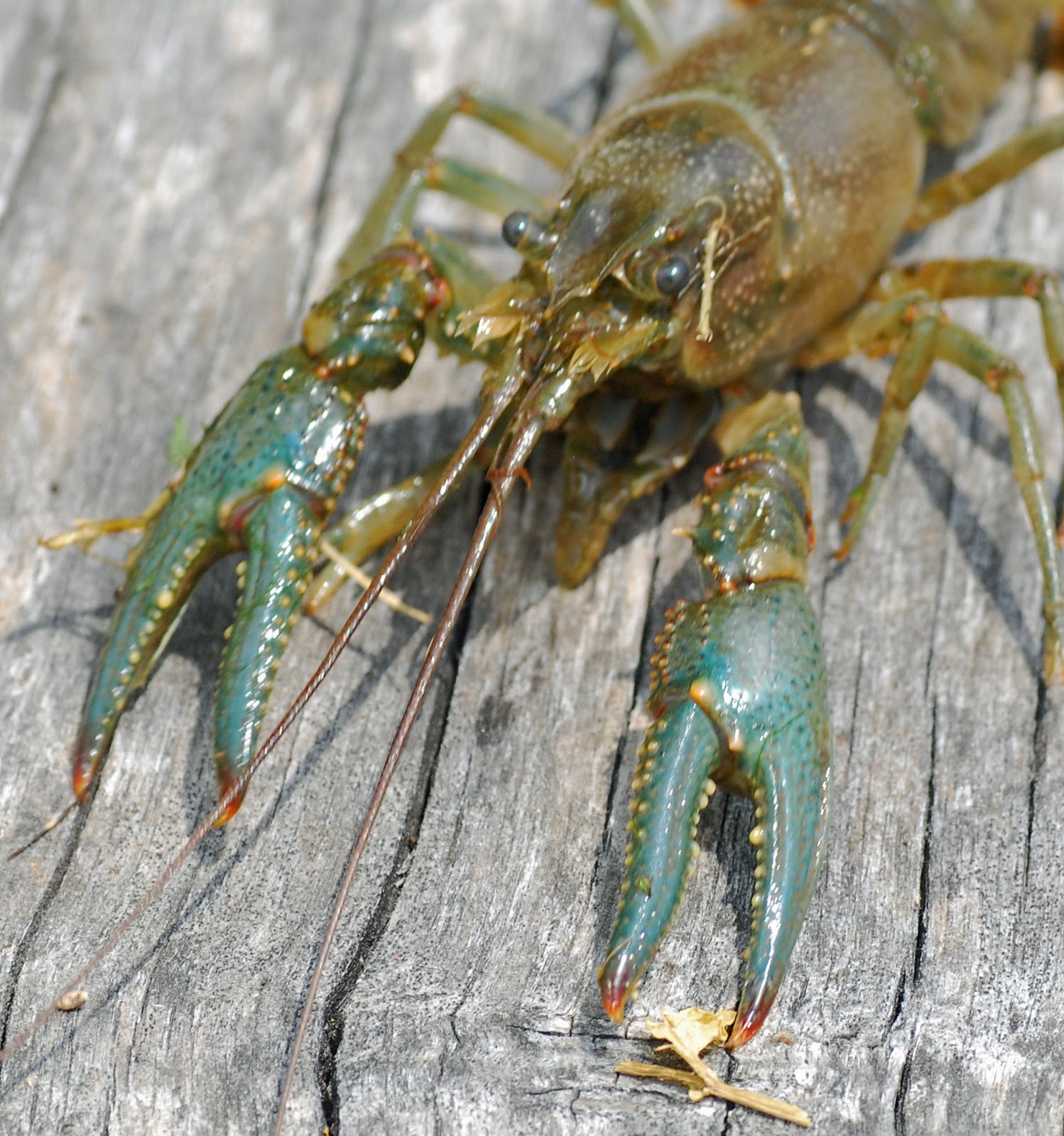
Northern Crawdad


Invertebrates come in all sizes, shapes, colors and species. Anything from worms to lobsters are types of invertebrates. Of course we probably wouldn't eat a worm (except on a dare), like we would lobsters, shrimps or even crawdads. In Missouri there are 35 native species of crawdads, and most of these live in the clear waters of Southern Missouri.
Northwest Missouri has 4 native species, and I believe the one pictured here is the Northern Crayfish (Orconectes virilis). They are one of the most widespread species of crawdads in Missouri, and also one of the largest. They can range in color from reddish to greenish with green or bluish-green pincers with yellowish bumps (tuberacles). They are capable of reaching lengths to nearly 5 inches. This species is commonly found in streams with plenty of sheltered areas like rocks, logs and organic debris. They are also found in ponds as long as the pond is not overrun with large predator fish like bass. The one pictured here was captured from under a large rock along the shore of our pond. After photographing it I released it. It was quite large at over 4 inches in length. In late summer or early fall this species will most likely seek deeper water to avoid the winter freeze. They will lay dormant throughout the winter at the bottom of the water, often covered with silt. They will become active with the return of spring warmth.


Northern Crawfish breeding begins in July and typically ends when cold weather sets in. Breeding may start back up with the return of spring. Males of this species will dig a tunnel that mating takes place in as well as egg brooding. Young are born from May to June. This species is prolific and highly adaptable. They are commonly reared as a food species because of their large size and are probably favored birds, mammals and fish alike as a source of food. Most crawdads are nocturnal and only hunt at night, they will feed on a variety of decaying matter, both plant and animal. They are important links in the food chain because of their ability to breakdown dead plant and animal material that would otherwise not readily decompose.


Crawdads are an important commercial and recreational resource in the United States. They are harvested for food not only as bait but also for human consumption. There are over 53,000 metric ton harvested annually, with 90% of those harvested coming from Louisiana. Many crawfish species are in danger of extinction because of inappropriate bait dumping. Many fisherman use crawdads as fish bait, and instead of disposing of their bait properly, they turn the crawdads loose. I am sure they think they are being more humane by letting the crawfish go, but in actuality it messes with the crawfish habitats. These non-native crawfish will often compete with native species for food sources. The non-native species will often mate with native species creating hybrids which in turn can cause the potential for extinction of native species. Often, hybrids are fertile and able to breed which can make it hard for native species to compete for mates. If you use crawdads as bait, remember to always throw your bait away, if this goes against your principles then return the crawdads to the tackle store where you bought them and return them. It is better to this than to releases them to wreck havoc on the aquatic environment.

Thursday, February 10, 2011

Leaf-Cutter Ants


The ants pictured here are leaf-cutter ants (Atta colombica) and are native to South America from Guatemala to Columbia (which may be where the species name originates from). There are also populations found in parts of Costa Rica. Although these ants aren't native to Missouri or anywhere else in North America they are still very interesting and right now they are on display at Reiman Gardens in Ames, Iowa at the Iowa State University. They have created a very unique and fun exhibit to showcase these ants, and if you are in the area it will be worth a visit to see these ants, as well as the rest of the Reiman Gardens exhibits, which includes a large butterfly pavilion.


These ants are reddish in color with a matte sheen, there are no shiny spots on these ants. These ants forage for leaves to cut and bring back to the nest that is used in a fungus garden. The fungus that is created from the fermenting leaves is eaten by the ants and fed to the offspring. When leaves rot or become otherwise unusable the ants will carry these leaves out in the form of refuse to an outside dump that is located to the side of the main soil mounds. These refuse dumps are cone-shaped and distinctive in appearance.


Occasionally these ants go a little crazy in the leaf-cutting department and cut more than the colony can consume. These excess leaves are cached on nearby trails or near the entrance to the nest. When more leaves are needed they will collect from these caches first before cutting more leaves. Sort of a "want not, waste not" mentality.


These are very interesting ants, not to mention beautiful and fun to watch. Hope you all get the  chance to visit Reiman Gardens to see these little ants hard at work.

Wednesday, February 2, 2011

Darkling Beetle


Darkling beetles in the family Carabidae Tenebrionidaeare ( Thanks Ted for catching my faux pas) one of the most common beetles in the pet trade. These larger beetles are called Zophobas morio and the larvae are called Superworms. They are native to Central and South America, but made their way into the United States because of their large size and easy to rear nature. Many captive pets prefer these larger worms in their diet, such as bearded dragons and other lizards, turtles, frogs, salamanders, birds and koi fish. Spiders and predatory insects may find them unpalatable due to their hard exoskeleton. The nutritional value of these superworms is comparable to mealworms so supplemental calcium should be used if these worms are a staple in your pets diet. The larvae are odor-free, although as adults they can give off an odor if provoked.
My bearded dragons "Lizzie and Dragon" love them and eat them as quickly as I give them to them. My daughter took a video of them with her I-phone (below).


Breeding populations can be started easily with just a few large size larvae. Place these larvae in individual containers with small holes in the lid. Do not feed them, and they will pupate faster.


In a few weeks the larvae will begin to molt and resemble something that looks like a cross between the larvae and the adult beetle it is soon to become. They will remain light in color. After this pupation they will emerge ass the adult beetle. The adults will be yellowish in color, then reddish, later becoming black. It will take them 3 to 4 days to finish this process. The larvae can be kept together in smallish sized containers to prevent pupation. The crowded conditions and close proximity to their neighbors inhibits their growth to adulthood.

Both as adults and larvae they are sensitive to cigarette smoke as well as incense. Exposure to smoke seems to make them hyperactive and should be avoided. They will eat most anything, carrots, potatoes, beans, oats, fruit, vegetables and the peels of oranges and bananas are all good food sources for these beetles.

These beetles were frequently used in the popular show "Fear Factor" and were consumed by the contestants, usually in the second round. Could you consume one of these worms on a dare?

Thursday, January 27, 2011

Black Field Cricket


One of the most common sounds of autumn is the call of the cricket in the family Gryllidae. These are known as the true crickets. The persistent chirping that these insects make drones on and on for what seems like an eternity; for some it is a sound that is almost musical. Their outdoor experience would not be complete without this beautiful chorus. For me however the sound these little ebony colored musicians play is akin to the sound of fingernails on a chalkboard. It is a brain piercing noise that makes my eyes twitch. So whether you love them or hate them one thing is for certain they are sure to be back each year.

The field cricket is a cold-blooded creature, just like all insects. They will take on the temperature of their surroundings. In essence what this means for the cricket is; the warmer the outside temperature, the faster and more energetic the he will sing. So in contrast when the temperature outside drops his chirping will slow down. Why do crickets sing in the first place? There are several reasons for all the noise. They advertise their presence to other males and chirp to warn them away, in theory it works like a no-trespassing sign “Keep out.” They also sing happily when they locate a particularly tasty food source. The most important reason for their singing is to attract nearby females with which to mate. With so many kinds of crickets out there how do they find each other? Each species has its own distinct call and females of their own kind can home in on the male’s song and locate the would-be suitor. How are they able to hear each other? They have special membranes located behind the middle-joint of each front leg, so essentially they have ears on their knees.

Mating takes place in the late summer or early fall. Females will use a long apparatus at the end of their abdomen called an ovipositor to inject, or deposit eggs within the soil. The eggs will stay protected within the soil all winter and hatch the following spring. The young nymphs are born looking very much like their adult counterparts, minus wings. As they feed and grow they will attain wings and reach their adult size by mid-summer. Crickets are omnivores and feed on a wide variety of foods including organic materials, decaying plant materials, fungi, and some seedling plants. Crickets will even eat their own deceased and weakened kind when there is no other food source available to them.

Crickets do have powerful mandibles (jaws) and can inflict painful bites, although these bites rarely break the skin. They are considered harmless to humans, as they do not spread any diseases or contaminate our foods. They can however be a nuisance, when they enter our homes. Sometimes they make it into our basements or worse yet our bedrooms. When one of these noisy creatures ends up in our bedroom I am up and out of the bed like a shot tearing apart the bedroom until I locate the trouble maker, all the while my husband is giving me the one-eyed, sleepy, what the heck are you doing look! I cannot sleep with one of these creatures chirping, I literally feel my eyeballs twitching with every chirp. To complicate matters, turning on the light to try and find it only makes the bug shut-up. Turn the light off, climb back into bed and it starts up again! GRRRR! After what seems like hours I finally track down the culprit and throw him outside (resisting the urge throw him in the toilet). There really isn’t any full proof way to keep them out of your house short of spraying chemicals along foundations to try and prevent them from coming in. Once the temperatures drop to freezing the crickets will die and it is up to eggs in the soil to carry on the next generation.

Crickets are found throughout history depicted in many cultures throughout the World. In China they are popular pets and are considered good luck. They are often kept in cages. In Mexico and Southeast Asia they are also used as a gambling or sports betting pastime. They are even considered a delicacy in Mexico and are consumed as part of their diet. In Brazil the singing of the cricket signals impending rain, or a financial windfall. In other parts of Brazil a black cricket in a room is said to predict illness within the household; gray one means money; and a green one signals hope. Still in other areas of Brazil they are killed immediately because of their association with death. In the United States cricket chirping is often used when a comedian tells a joke and it flops. Instead of laughter or clapping you hear the sound of chirping crickets. Walt Disney made one cricket very famous; Jiminy Cricket played the part of Pinocchio’s conscience, and continues to be the most recognized off all cartoon insects.

Crickets are nocturnal, and therefore typically only heard close to sundown and throughout the night. During the day they hide out under rocks, rotting wood, or in dense vegetation. It seems that their populations vary year to year. Some years they seem to be everywhere we look, and other years their numbers are small by comparison. These crashing populations could be victims of severe winter temperatures and ground freezing. They could also be victims of predation as there are many ground dwelling insect larvae that feed on the eggs of crickets. In years when these predators are more abundant then the cricket populations are sure to suffer as a result. Then the following year after a majority of the crickets have been consumed, the predator’s population will dwindle and the crickets rebound.

So while these noisy little creatures can be a nuisance and drive many of us crazy with their insistent singing, I have to admit being outside would not carry with it the same attraction without them. Sitting outside near a campfire, fishing and enjoying a starry night is made all the more special by the chorus of crickets in the background.

Saturday, January 15, 2011

Batty for Bugs...or...Buggy for Bats


 Bats are mammals, and certainly not an arthropod, but I figured since they feed on numerous insects it would be okay to feature a couple of bats that came into my possession this past week. They have long been one of my favorite creatures. I've put up bat houses to encourage them to take up residence on our farm. So far they have not used the houses, but I do see bats feeding on the insects at the pole lights.


This face that only a mother could love belongs to an Evening Bat (Nycticeius humeralis) and it showed up in a persons house in St. Joseph. Animal Control was called and rescued the bat. I received a phone call asking me if I would take it and find a safe place to release it. It is very difficult in the winter to rescue these little guys. Releasing them outside is obviously out of the question and not just any location will meet their requirements. The area must be cold in order to encourage hibernation, yet not too cold to freeze them to death. It cannot be too warm or it will encourage them to awaken and fly around. This activity will cause them to use up valuable fat stores and may result in them being unable to survive the rest of the winter. Fortunately on our farm we have such a location in the form of an old farrowing house. It is a large building with a peaked ceiling. We have a small amount of heat in the building to keep water lines from freezing. You can still see your breathe in the building. So I captured a few quick images of this little beauty and then quickly placed it in the farrowing house.

Evening bats are very common in the Southern half of the United States, and are often found with Big Brown Bats and Brazilian Free-Tail Bats. They very much resemble Big Brown Bats and are often mistaken for them. Evening Bats are smaller, uniformly dark brown in color, and have black ears, wings and tail membrane. Their nose lacks fur. They measure up to 3.5 inches in length and have a wingspan up to 11 inches. They weigh up to 1/2 ounce.  In the northern part of their range they are less common and will migrate to hibernation locations. Sometimes they travel great distances to reach these winter roosting sights. In Missouri they seem to use attics and other locations to spend the winter.This species is often seen roosting in towns and rural areas. Males will form harems and defend their females from other male Evening Bats. Females give birth to one or two pups. Occasionally three pups may be born. They seem to suffer separation anxiety from their mothers and are very vocal when their mothers are out of their sight. The young are ready to leave and fly at 20 days. In autumn the young males are cast out of the colony and may show up in odd places like the eaves of houses or outdoor stairwells.

 Large colonies (up to several hundred individuals) will be found roosting together in old buildings. Smaller colonies (up to 40 individuals) will roost under the loose bark of trees where they squeeze close together to accommodate the tight quarters. In early spring they come out of hibernation and begin foraging for insects early of an evening. They feed on beetles, leafhoppers, flies, moths and ants. Evening Bats are important predators of the Spotted Cucumber Beetle, making them a friend to farmers and gardeners alike. These particular bats often find themselves prey to feral cats and many are sacrificed to hungry wild kitties all over the southern states.


This tiny little bat is a Little Brown Bat (Myotis lucifugus). This species is a member of the "Mouse Eared Bats (myotis) and were at one time the most common bat found in their range. There are reports however that claim their numbers are declining and they are becoming more difficult to find in the populations that they previously occurred. No one seems to know how or why this is. Is it a disease? Are they victims of predation? Is it loss of habitat and suitable roosting sights? Hopefully research will bring about the answers before their numbers fall too dramatically. This one too showed up in a persons house and needed rescuing. The gentleman at Animal Control wanted to know why bats were suddenly showing up in peoples homes, especially now during the coldest spell we've had so far this winter. I told him it could be one of several reasons. First being the actual cold that should keep them sleeping. It seems that at 30 degrees or warmer they rest contentedly. When the temperature drops another 30 degrees like it has this past week they become aggitated and begin  looking for warmer environs. This often leads to them finding their way into the living quarters of whatever dwelling they are roosting in. Second reason could be a disturbance of some kind. Perhaps loud noises or unusual activity awoke them and roused them out of their winters sleep. This too would result in them flying around and becoming disoriented and ending up in your house. Too many disturbances is dangerous for them. It is imperative they return to slumber quickly and with as little fuss as possible.

The Little Brown Bat species is very small at 2.4 -4.0 inches in length and a wingspan up to 11 inches. They weigh a mere 1/2 ounce. They have shiny pale brown to dark brown fur. Their coat is evenly covered, and the hairs on their toes extend to cover the toenails. This is a long lived species and may live up to 34 years, with males living longer than females.

Little Brown Bats roost in hot attics during the summer in colonies they may number up to 1,000 members. They will roost in bat houses and other man made structures in smaller numbers. They will even use dead or decaying trees as roosts. Their roosts will generally be located near water. They mate in the fall and the females will store sperm until the following spring. This ability to delay fertilization assures the pups won't be born while the mothers are hibernating.  The female will give birth to one pup sometime in May, June or July. They are born furless, and with their eyes closed. They will rest under their mothers wings during the day, then at night the mothers leave them in the roost so they can go out and forage for insects. They typically eat mayflies, crane flies, moths, gnats and beetles. They are capable of eating their entire body weight in insects in a single night.  Most hunting grounds are located near water, like ponds. They capture several hundred mosquito sized insects in a single hour. Pups are able to fly at 2 weeks of age, and will be adult sized in approximately 20 days. When fall returns they will seek their winter hibernation spots that may contain up to 300,000 individuals.

There are fourteen species of bats living in Missouri and each of them are insect eaters. We do not have vampire bats or fruit bats in Missouri. Therefore all Missouri bats are helpful to us by controlling insect populations. It has often been said that they eat thousands of mosquitoes in a single evening. While it is true that they are capable of eating mosquitoes, they however prefer larger prey insects like moths. The larger the insect the more energy and calories gained. It is kind of like showing up at a buffet and choosing to eat a salad. Does any of us really do that? Nah, of course not.....


 Bats do however carry rabies, and this is a very real threat. Approximately 40 cases are reported annually in Missouri of bats that test positive for rabies. Considering there are millions of bats living in Missouri this is a relatively low number. There are about 1/2 of 1 percent of bats that carry the virus. Bites typically occur when people find a bat out during the day and handle the bat, or they handle one that mistakenly makes its way into your home. Never under any circumstances handle a bat that is out during daylight hours, instead call your local Animal Control Center. If one makes it into your home, use caution and never try to handle one without sufficient gloves. It is best to call Animal Control.

Our local Animal Control has me on their call list to take bats for release and rehab. I have completed training through a licensed Wildlife rehabilitation Center and have my name listed with the Missouri Department of Conservation.

There is no reason to live in fear of bats, they are one of the cleanest animals in existence. They spend a huge amount of time grooming themselves. The chance of rabies infection is low, and they provide valuable insect control. Lastly they are just plain cool!!!!